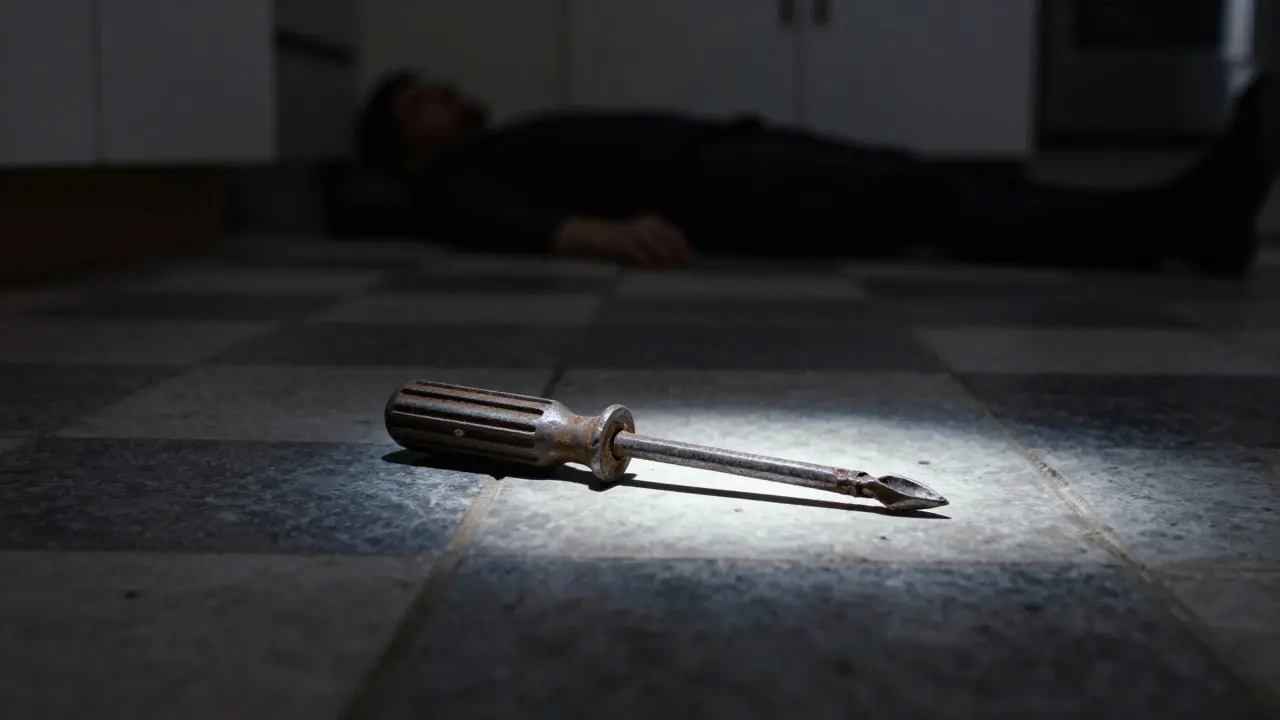
Imagine you are standing in a dimly lit kitchen at 2:00 AM. A victim lies on the floor, and next to them is a single, rusted screwdriver. To a layperson, it’s just a tool. To a forensic investigator, it is a physical evidence that could determine who committed the crime, when they did it, and what their intent was. But here is the catch: if your written description of that screwdriver is vague, incomplete, or inconsistent, its value in court drops to zero. The difference between a conviction and an acquittal often hinges not on the object itself, but on how well you documented it before it left the scene.
Writing an effective evidence description is less about creative writing and more about engineering precision. You are building a bridge between the chaotic reality of a crime scene and the structured environment of a courtroom. If the bridge has gaps, the jury cannot cross it. This guide breaks down exactly how to capture physical items with the level of detail required by legal standards, ensuring your notes hold up under cross-examination.
Why Vague Descriptions Fail in Court
We have all seen the classic mistake: "A knife was found near the body." Which knife? How long was it? Was the blade sharp or dull? Did it have a wooden handle or plastic? These details matter because they connect the object to specific actions. A 6-inch steak knife suggests a different narrative than a 12-inch machete.
Vagueness invites doubt. Defense attorneys love to poke holes in ambiguous reports. If you describe a stain as "dark liquid," the defense can argue it was coffee. If you specify "viscous, reddish-brown fluid with a metallic odor consistent with blood," you narrow the possibilities significantly. Precision limits the room for alternative explanations. Every adjective you choose should serve a forensic purpose, not just aesthetic one.
The Core Components of a Solid Evidence Description
A robust description follows a logical sequence. Start with the obvious, then move to the specifics. Here is the standard framework used by professional investigators:
- Category: What type of item is it? (e.g., firearm, biological sample, digital device).
- Brand/Model: If visible, note the manufacturer and model number. This allows for database lookups later.
- Dimensions: Length, width, height, and weight. Use standard units (inches/cm) and be precise to the nearest measurable unit.
- Color and Texture: Describe the primary color, any patterns, and surface feel (smooth, rough, corroded).
- Condition: Is it intact? Broken? Stained? Corroded? Note any damage.
- Distinguishing Marks: Serial numbers, scratches, engravings, or unique defects.
For example, instead of "a broken glass bottle," write: "A 12-ounce brown glass beer bottle, brand 'Pabst,' with a jagged break across the neck approximately 3 inches from the base. The interior residue is clear and viscous. No cap present." This level of detail allows a lab technician to reconstruct the item’s state without seeing it.
Handling Biological and Fragile Items
Not all evidence is sturdy. Biological samples like blood, hair, or tissue require special care in documentation because they degrade quickly. When describing these, focus on the medium and the preservation method.
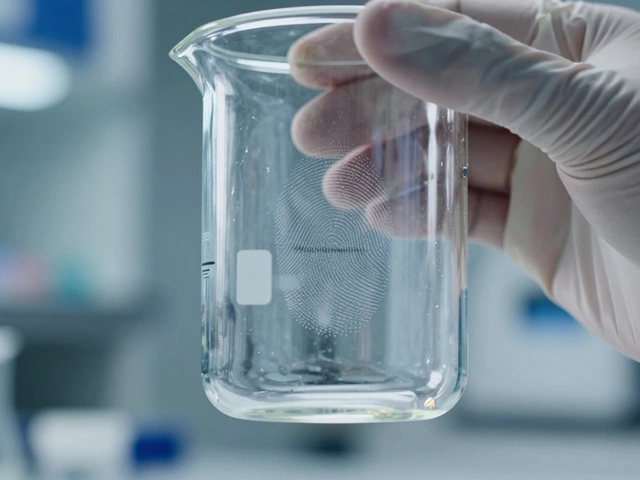
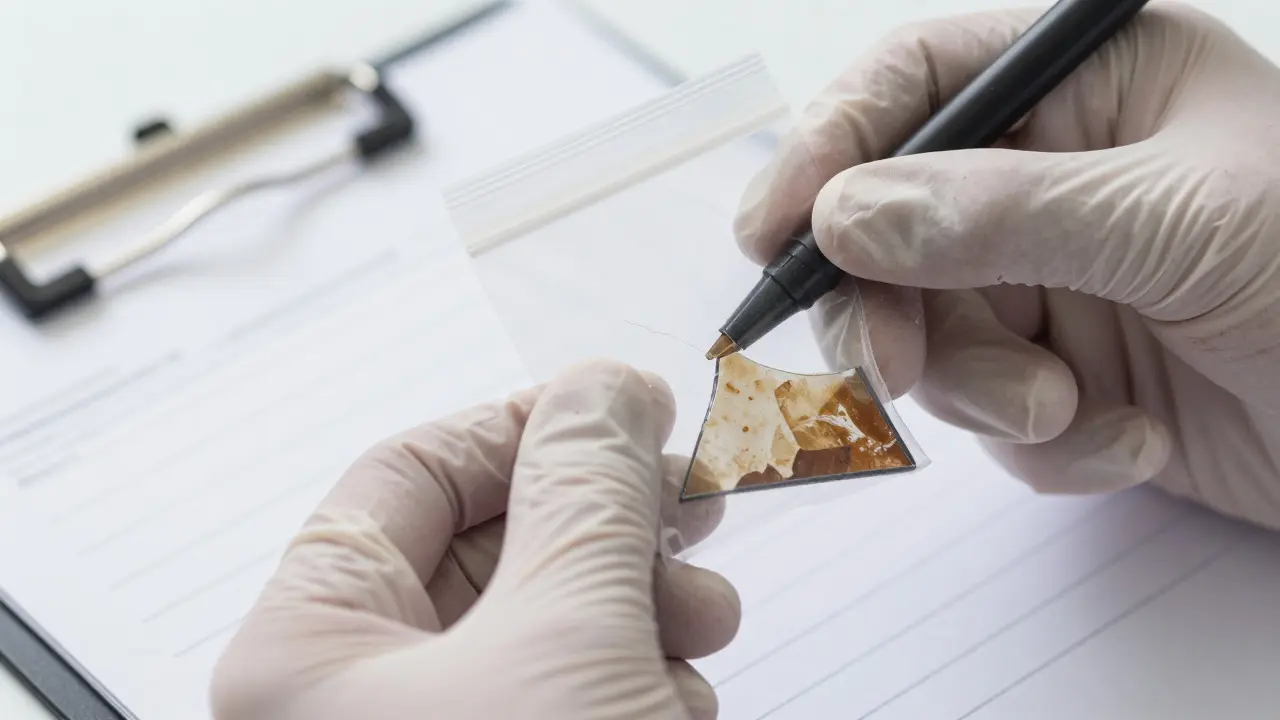
If you collect a blood stain, document its shape (linear, circular, spatter), size (diameter in mm), and location relative to fixed points. For trace evidence like fibers or hairs, note the color, length, and whether they appear natural or synthetic. Always mention the collection method: was it swabbed, lifted with tape, or placed in a vial? This context is crucial for the laboratory to interpret the results correctly.
Remember, time is the enemy of biological evidence. Your description should implicitly convey urgency. Noting that a sample was "collected within 5 minutes of discovery" adds credibility to the integrity of the sample.
The Role of Chain of Custody in Documentation
An excellent description is useless if the chain of custody is broken. Chain of custody is the chronological documentation showing the seizure, control, transfer, analysis, and disposition of physical evidence. Your initial description is the first link in this chain. It must match every subsequent entry.
When you hand off an item, the receiving officer must verify that the physical item matches your written description. If you wrote "blue shirt" but the bag contains a green shirt, the case is compromised. Therefore, double-check your labels against your notes before sealing the package. Consistency is key. If the serial number on the evidence tag doesn’t match the serial number in your report, you’ve created a discrepancy that will haunt the trial.
Common Pitfalls to Avoid
Even experienced investigators make mistakes. Here are the most common ones:
- Using Subjective Language: Avoid words like "obviously," "clearly," or "suspicious." Stick to observable facts.
- Omitting Negatives: If there are no fingerprints on a gun, note it. The absence of evidence is also evidence.
- Mixing Units: Don’t switch between inches and centimeters in the same report. Pick one and stick to it.
- Ignoring Context: An item found in a pocket means something different than one found in a trash can. Always note the location relative to the victim or other objects.
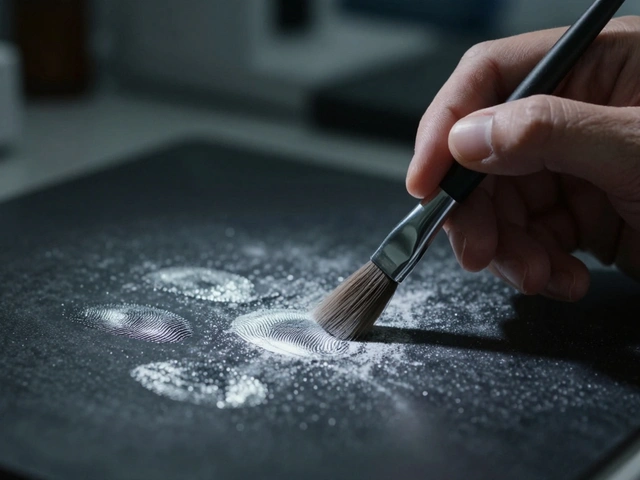
Another frequent error is failing to photograph the item before packaging. Your written description is static; photos provide visual proof. Ensure your notes reference specific photo numbers so the judge can cross-reference the text with the image.
Best Practices for Digital Devices
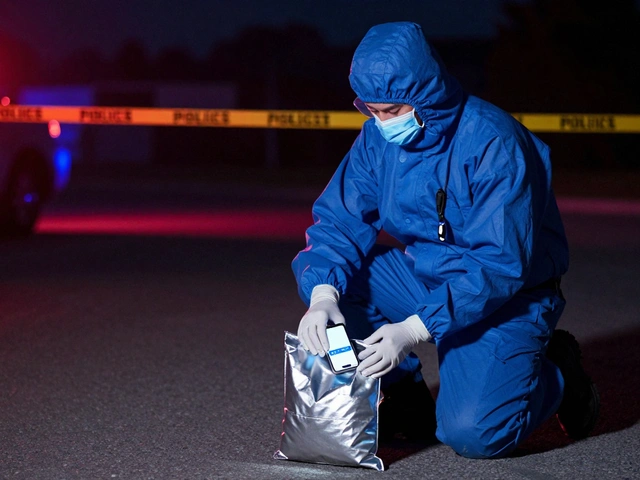
With the rise of smartphones and laptops, digital evidence has become central to many cases. Describing these items requires a hybrid approach. You need to document the physical hardware (brand, model, screen condition, battery status) and the logical state (locked, unlocked, charging, airplane mode).
For instance: "Samsung Galaxy S24, black, 6.8-inch display, cracked corner on top right. Device was powered on, screen displayed lock screen with password prompt. Battery level at 40%. Found in victim's left jacket pocket." This dual-layer description helps digital forensics experts understand the starting point of their investigation.
Comparison: Good vs. Bad Descriptions
| Aspect | Ineffective Description | Effective Description |
|---|---|---|
| Specificity | A knife was found. | Victim-owned chef’s knife, 8-inch stainless steel blade, black rubber handle, slight nicks on edge. |
| Condition | It looked dirty. | Blade covered in dark red substance, consistent with dried blood. Handle has partial fingerprint smudges. |
| Location | Near the body. | Found 2 feet north of victim’s head, partially buried in carpet fibers. |
| Context | Seized by Officer Smith. | Collected by Officer Smith at 14:30 hours, packaged in paper envelope, labeled EV-001. |
Frequently Asked Questions
How detailed should an evidence description be?
As detailed as necessary to allow a third party to identify the item without seeing it. Include dimensions, colors, brands, conditions, and distinguishing marks. If a detail could help link the item to a suspect or victim, include it.
What if the item is damaged or altered after collection?
Document the change immediately in the chain of custody log. Note who handled it, when, and why. Transparency prevents accusations of tampering. A noted alteration is manageable; an unexplained one is fatal to the case.
Should I use technical jargon in my descriptions?
Use plain language for general descriptions and technical terms only when defining specific forensic states (e.g., "spatter pattern," "fracture line"). Jargon can confuse jurors, so prioritize clarity over complexity.
How do I describe irregular shapes?
Use comparisons to common objects (e.g., "approximate size of a dime") and measure the longest and shortest axes. If possible, sketch the shape or take multiple angled photos to capture the three-dimensional form.
Is it okay to leave out minor details to save time?
Only if the detail is truly irrelevant to the case. However, when in doubt, include it. Extra information costs little time but can be invaluable during trial preparation. Missing a critical detail is much harder to fix than including an extra one.