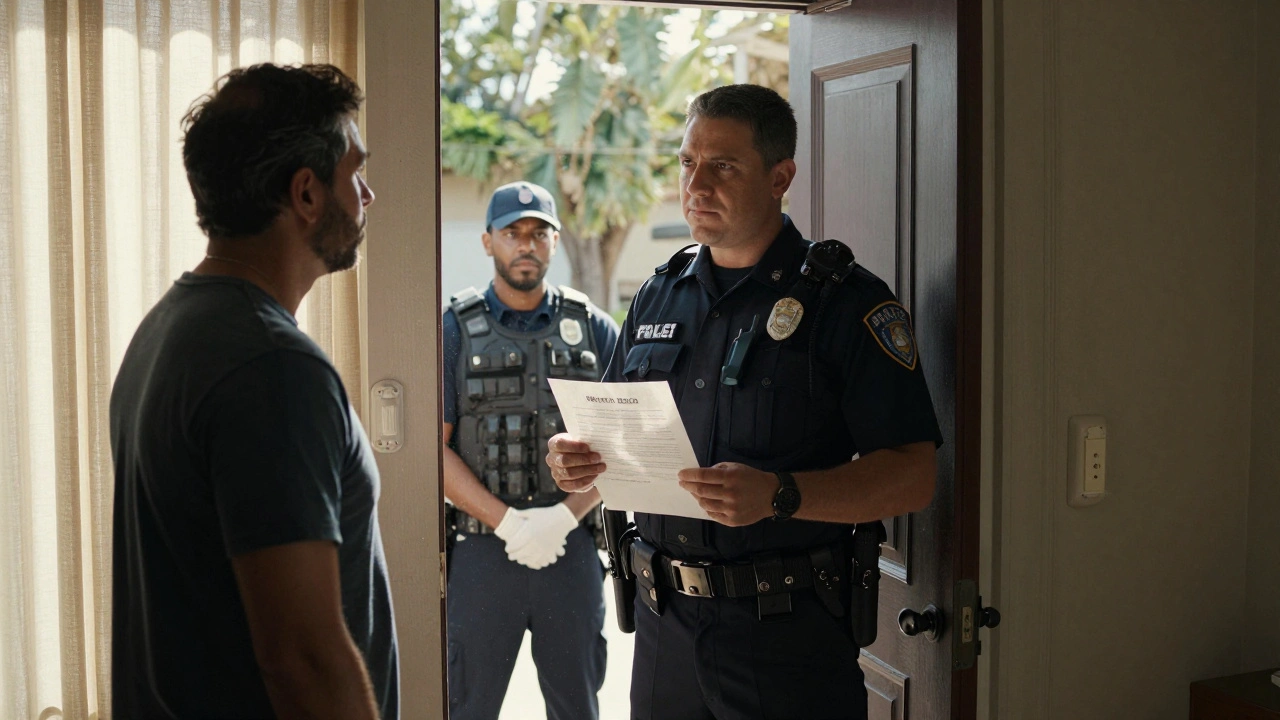
When police show up at a crime scene, they don’t just walk in and start collecting evidence. There’s a legal framework that controls exactly how they can enter, search, and seize items. If they skip the rules, everything they find could be thrown out in court. The key to lawful crime scene investigations comes down to three things: warrants, consent, and exigency.
Warrants: The Default Rule
The Fourth Amendment to the U.S. Constitution protects people from unreasonable searches and seizures. That means police generally need a judge’s permission-a warrant-to search a home, car, or other private space. Getting one isn’t easy. Officers must submit a written affidavit showing probable cause. That doesn’t mean they have to prove guilt beyond a doubt. It just means they need facts that would lead a reasonable person to believe evidence of a crime is likely there.
For example, if a neighbor reports seeing blood on the floor of a house and hears screams from inside, that’s enough to build probable cause. The affidavit must clearly state what’s being searched for, where it’s located, and why. A warrant isn’t a blank check. If the warrant says to search the master bedroom for a stolen laptop, police can’t go into the garage and start digging through tools. Anything found outside the warrant’s scope might be ruled inadmissible.
Some warrants are even more specific. A DNA warrant, for instance, doesn’t let police search your house. It only authorizes them to swab your cheek for genetic material. If they find a gun in your kitchen while executing a drug warrant, they can seize it-but only because it’s illegal to possess. That’s the plain view doctrine. If evidence is clearly visible and officers are legally allowed to be where they are, they don’t need another warrant to take it.
Consent: Voluntary Permission
Police don’t always need a warrant if someone with authority gives them permission. This is called a consent search. A homeowner can say, “Come in and look around.” A driver can agree to let officers search the trunk. But consent has to be real. You can’t be pressured. You can’t be tricked. And you can always say no.
Here’s how it works in practice: If police knock on your door and ask, “Can we look inside?” you don’t have to let them in. If you say yes, they can search wherever you allow. But if you say no, they must stop unless they have another legal reason to enter. Some people think saying “I don’t consent” will make police angry. It won’t. It’s your right. And if you’re unsure, just say, “I want to speak to a lawyer first.”
Consent can be limited, too. You can say, “You can look in the living room, but not the bedroom.” If they go beyond that, any evidence they find may be thrown out. Courts also look at who gave consent. If two people live in a home and one says yes while the other says no, the police can’t search. The person who refuses has the final say.
Exigency: Emergency Exceptions
There are times when waiting for a warrant could mean someone dies, evidence is destroyed, or a suspect escapes. That’s where exigent circumstances come in. These are emergencies that justify immediate entry without a warrant.
Common examples: hearing screams from inside a locked house, seeing a suspect run into a building with a weapon, or smelling burning marijuana while standing at a front door. In these cases, police can enter without a warrant to stop harm or preserve evidence.
But exigency isn’t a loophole. It has to be real. In the 1978 Supreme Court case Mincey v. Arizona, police searched a man’s apartment after he was shot. They claimed it was for “evidence preservation.” The Court said no. Everyone was already secured. The scene was safe. There was no emergency. The search was illegal.
At crime scenes with a dead body, police often enter without a warrant-but not to investigate a murder. They’re there to assist the coroner. Under laws like the Police Powers and Responsibilities Act, officers can secure the scene, take photos, and prevent contamination. But they can’t start searching for suspects or digging through drawers. That’s the coroner’s job, not theirs. Once the coroner confirms a crime likely occurred, police must get a warrant to continue.
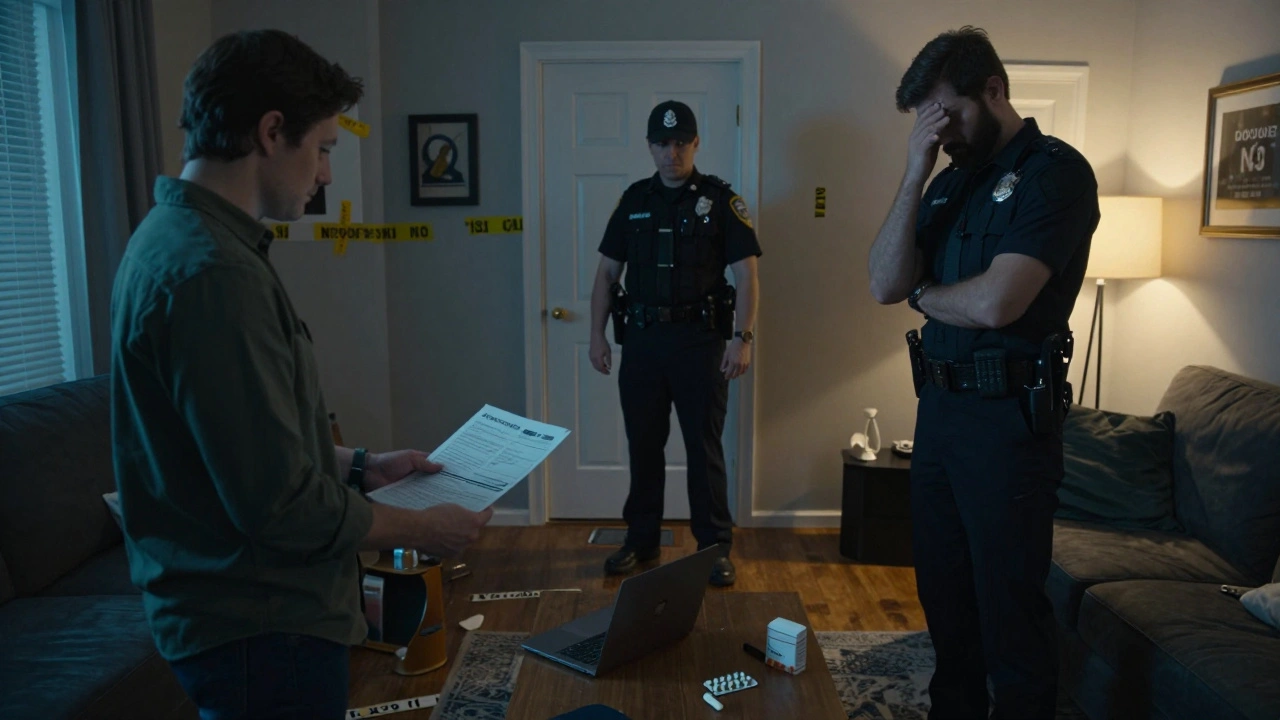
Plain View and Other Exceptions
The plain view doctrine is one of the most misunderstood exceptions. It doesn’t let police rummage around. It only applies when three things happen together:
- The officer is lawfully present (e.g., they have a warrant for one room or are responding to a call).
- The evidence is immediately recognizable as illegal (e.g., a bag of pills on a counter).
- The officer has a lawful right to access the item (e.g., it’s visible from where they’re standing).
Let’s say officers have a warrant to search a kitchen for stolen electronics. While there, they notice a pile of cash taped under a sink. They didn’t know about it before. But they know it looks like drug money. They can seize it. But if they open a drawer they weren’t authorized to open and find the cash, that’s a problem. The plain view rule doesn’t let them move things around to find evidence.
Another exception is the “hot pursuit” rule. If a suspect runs into a house while being chased by police, officers can follow without a warrant. Same with a fleeing suspect who dives into a neighbor’s yard. The urgency of catching someone overrides the need for a warrant.
Who’s in Charge at the Scene?
At a crime scene, authority shifts depending on who’s there. First responders secure the area. Detectives take over for investigation. Then forensic technicians arrive-and suddenly, they’re in charge. Forensic scene managers have the legal authority to order police officers out of the scene so they can process evidence without contamination.
This isn’t about power trips. It’s about science. If officers keep walking around in boot prints or touching surfaces, they ruin DNA and fingerprints. Once forensics finish their work, they hand control back to detectives. One person always leads the scene. Even if ten people are there, only one has final say. That’s how chains of custody stay intact.

What Happens If Police Break the Rules?
If evidence is collected without proper legal authority, it’s likely to be excluded under the exclusionary rule. That means prosecutors can’t use it in court-even if it proves guilt. A murder weapon found during an illegal search? Gone. A laptop with incriminating emails? Gone. A confession made after an unlawful entry? Also gone.
There are rare exceptions. If police acted in good faith-like relying on a warrant later found to be flawed-the evidence might still be admitted. But those cases are narrow. Most of the time, a mistake in procedure kills the case.
That’s why officers are trained to document everything. Every step. Every decision. Every reason they entered, searched, or seized. If they can’t explain it in court, they lose.
State Variations Matter
Federal rules are the baseline, but states add their own layers. In Texas, for example, search warrants must be executed within three days. In some states, warrants expire in 48 hours. Some states require police to knock and announce before entering. Others allow no-knock warrants under specific conditions.
Also, state constitutions sometimes offer more protection than the U.S. Constitution. California, for instance, has stricter rules about warrantless searches of cell phones. Oregon, where this is being written, requires warrants for most digital searches-even if the phone is found at a crime scene.
That’s why police often consult legal advisors before acting. What’s legal in one state might be illegal in another. A warrant that’s valid in Florida might not hold up in New York.
What You Need to Remember
- Warrants are the rule. Exceptions are narrow.
- You can refuse consent. Saying no isn’t an admission of guilt.
- Exigency means real danger-not convenience.
- Plain view only works if officers are already legally allowed to be there.
- Forensics take over at the scene. Police step back.
- Illegal searches mean lost evidence, no matter how damning.
Crime scene investigations aren’t about speed. They’re about legality. Every decision must be backed by law. Otherwise, justice doesn’t just fail-it collapses.