You spent weeks analyzing the evidence. You ran the tests twice. The data is solid. But then you read your draft report, and something feels off. It’s not wrong, exactly, but it’s confusing. In forensic reporting, the process of documenting scientific findings for legal proceedings, clarity isn’t just a nice-to-have; it’s the difference between a conviction and a mistrial. A perfectly accurate finding can be completely useless if the judge or jury interprets it incorrectly.
Misinterpretation usually happens because experts forget who they are writing for. We speak in probabilities, p-values, and confidence intervals. Lawyers speak in narratives, motives, and definitive answers. When these two languages collide without a translator, errors happen. This guide breaks down the most common pitfalls in forensic documentation and how to fix them before they end up in cross-examination.
The Gap Between Scientific Certainty and Legal Clarity
Science deals in uncertainty. Law deals in binary outcomes: guilty or not guilty, liable or not liable. When you write "there is a 95% probability this fiber matches," a scientist hears high confidence. A layperson might hear "it’s probably right." That ambiguity is where defense attorneys thrive.
A frequent error is using technical jargon as a shield. If you write "chromatographic retention time deviation was within acceptable parameters," you’ve described the science but failed to explain the implication. Instead, try framing the result in terms of its evidentiary value. Did the test rule out other sources? Did it link the suspect to the scene? Translate the data into action.
Consider the difference between saying "no significant difference was observed" versus "the samples are consistent with each other." The first is statistically true but legally vague. The second tells the reader what they need to know: these items likely came from the same place. Always ask yourself: if I were the prosecutor, would this sentence help me build my case? If I were the defense, could I twist this sentence to mean something else?
Ambiguity in Language and Terminology
Vague words are the enemy of precision. Words like "consistent," "similar," and "likely" carry heavy weight in court but have no fixed definition outside of specific statistical contexts. Without defining your terms, you invite subjective interpretation.
For example, if you state that a DNA profile is "consistent with" a suspect, you must clarify what that means. Does it exclude everyone else in the population except close relatives? Or does it simply mean the alleles match? In many jurisdictions, stating that a profile is "consistent with" someone implies inclusion, but failing to state the random match probability (RMP) leaves the strength of that inclusion undefined.
- Define your limits: Explicitly state what your analysis cannot do. If you couldn't determine the origin of a stain, say so early.
- Quantify uncertainty: Don't just say "high likelihood." Give the number. "One in ten million" is harder to argue with than "very rare."
- Avoid absolute claims unless certain: Unless you have 100% certainty (which is rare in forensics), avoid words like "proven," "definitive," or "unique." Use "supported by," "indicates," or "matches."
A classic mistake in fingerprint analysis is claiming uniqueness without context. While fingerprints are generally considered unique, partial prints on textured surfaces introduce variables. Stating "this print identifies the individual" ignores the margin of error inherent in partial latent lifts. Better phrasing: "The ridge characteristics observed are sufficient to establish identity based on standard ACE-V methodology."
Structural Flaws That Hide Key Information
Even perfect content fails if the structure buries the lead. Many forensic reports follow a chronological lab notebook format: collection, preparation, testing, results. This makes sense for peer review but frustrates legal teams who want the bottom line immediately.
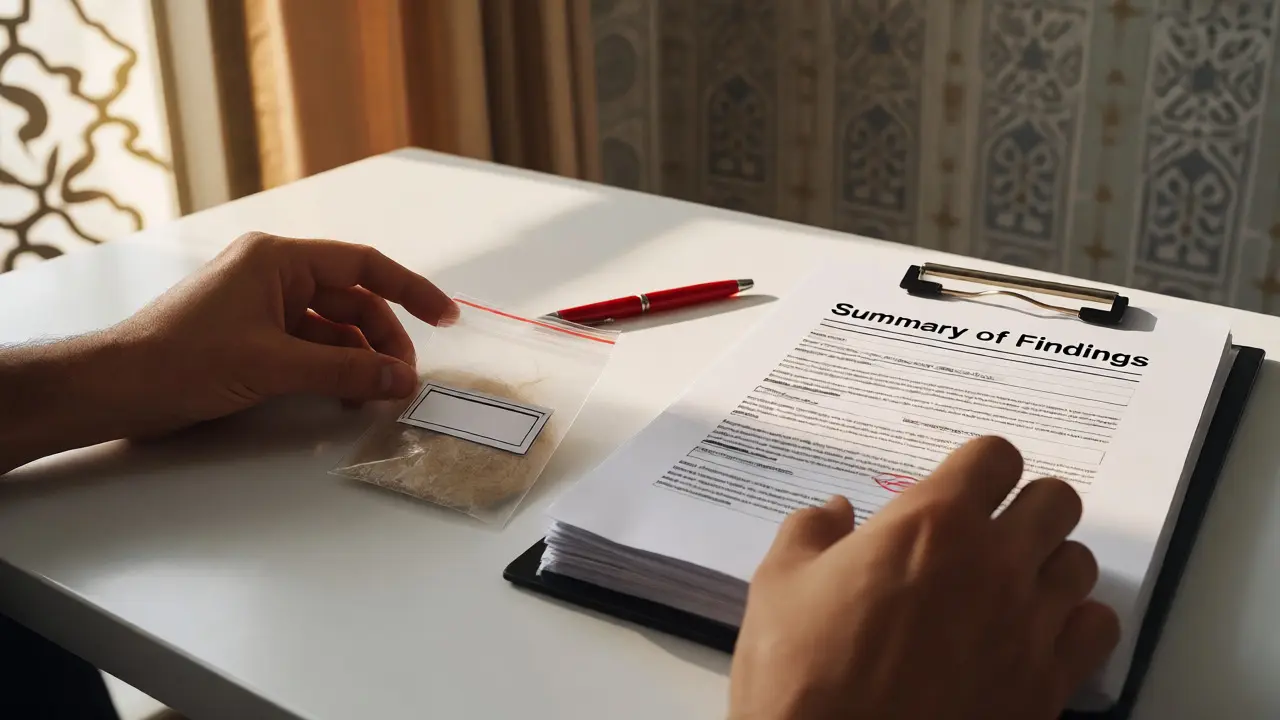
Structure your report for the end-user. Start with an Executive Summary or Conclusion section that states the key findings upfront. Then provide the supporting details. Think of it like a news article: headline first, body later.
| Feature | Traditional Lab Format | Legal-Focused Format |
|---|---|---|
| First Section | Introduction & Methods | Summary of Findings |
| Data Presentation | Raw tables and graphs | Interpreted charts with captions |
| Conclusion Placement | End of document | Beginning and End |
| Primary Audience | Other Scientists | Judges, Juries, Attorneys |
If you bury the conclusion on page 40, you risk having it overlooked during rapid discovery reviews. Make it easy for non-experts to find the answer they’re looking for.
Omitting Context and Limitations
No forensic method is perfect. Every technique has limitations, whether due to sample degradation, environmental contamination, or instrument sensitivity. Failing to disclose these limitations is one of the fastest ways to get impeached on the stand.
Imagine you analyzed a blood sample found at a crime scene. The sample was old and partially degraded. Your DNA test yielded a partial profile. If you don’t mention the degradation, the prosecution might assume the full profile was available. Later, when you admit on the stand that the sample was compromised, it looks like you hid material facts.
Include a dedicated "Limitations" section. Be honest about what you didn’t test and why. Did you skip a toxicology screen because the volume was too low? Say so. Did you rely on a database that hasn’t been updated since 2020? Note it. Transparency builds credibility. Concealment destroys it.
Also, consider the chain of custody gaps. If there was a two-day delay between collection and storage, mention it. Even if it didn’t affect the result, acknowledging it shows you understand the procedural integrity required in criminal justice.
Visuals That Confuse More Than They Clarify
Charts, graphs, and photos are powerful tools, but only if they are labeled correctly. A common error is including a complex chromatogram without explaining what the peaks represent. To a lawyer, that squiggly line is meaningless noise.
Every visual needs a clear caption and a legend. If you show a graph comparing two samples, annotate the points of similarity. Use arrows or circles to highlight the relevant features. Remember, the jury will look at your image while listening to your testimony. If they can’t see what you’re pointing out, they’ll tune out.
Color choice matters too. Avoid red-green combinations if possible, as color blindness affects roughly 8% of men. Use high-contrast colors and distinct patterns (dashed vs. solid lines) to ensure accessibility. And always include a scale bar on photographs. An unlabelled photo of a bullet fragment gives no sense of size, leading to immediate questions about relevance.
Logical Fallacies in Interpretation
Sometimes the error isn’t in the data, but in the logic connecting the data to the conclusion. The most dangerous fallacy in forensics is the Prosecutor’s Fallacy. This occurs when the probability of the evidence given innocence is confused with the probability of innocence given the evidence.
Example: "The chance of a random person matching this DNA is 1 in a billion. Therefore, the chance the suspect is innocent is 1 in a billion." This is false. The prior probability of guilt depends on other evidence, not just the DNA match. Your report should stick to the likelihood ratio or random match probability without making ultimate issue statements about guilt.
Another trap is assuming causation from correlation. Just because two fibers matched doesn’t prove contact occurred recently. Fibers transfer easily and persist. State that the fibers are "consistent with contact," not that they "prove contact." Let the trier of fact decide the weight of that consistency.
What is the biggest mistake forensic experts make in reports?
Using overly technical jargon without explaining its practical implication. Experts often describe the method rather than the meaning of the result, leaving lawyers and judges confused about the evidentiary value.
How should I handle inconclusive results?
Be explicit. State clearly that the test did not yield a conclusive result and explain why (e.g., insufficient sample, interference). Do not leave the reader guessing whether "no result" means "negative" or "unable to determine."
Should I include raw data in the main report?
Usually, no. Put summaries and interpreted data in the main text. Include raw data, such as full chromatograms or log files, in appendices. This keeps the narrative flow clean while providing backup for scrutiny.
What is the Prosecutor’s Fallacy?
It is a logical error where the probability of observing the evidence if the defendant is innocent is mistaken for the probability that the defendant is innocent given the evidence. Forensic reports should present statistics neutrally to avoid this trap.
How detailed should the methods section be?
Detailed enough for another qualified expert to replicate the work, but concise enough for a layperson to understand the general approach. Cite standard operating procedures (SOPs) by name rather than describing every step in prose.
Final Checks Before Submission
Before you sign off, run through this checklist:
- Read it aloud: If you stumble over a sentence, rewrite it. Awkward phrasing signals confusion.
- Check for absolutes: Replace "always," "never," and "proven" with qualified language unless mathematically justified.
- Verify consistency: Ensure numbers in the summary match the data in the appendix. Discrepancies here raise red flags.
- Ask a non-expert: Have a colleague outside your specialty read the conclusion. Can they summarize the finding in one sentence? If not, simplify.
Remember, your job isn’t just to analyze evidence; it’s to communicate truth. A well-written report respects the court’s time and the defendant’s rights. By avoiding these common errors, you protect the integrity of your work and strengthen the foundation of justice.