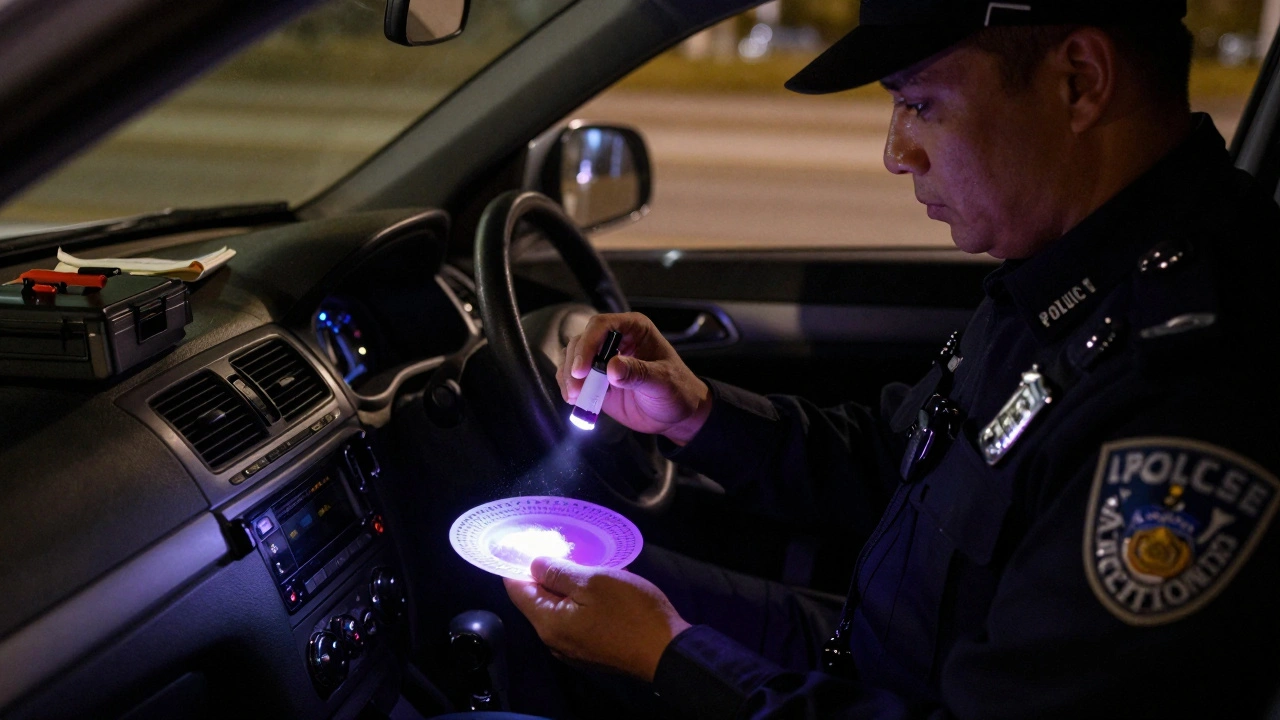
When police officers pull over a vehicle and find a small white powder, they don’t wait days for a lab to confirm what it is. They use a simple vial, a drop of liquid, and watch what happens. That’s the power of color reagent tests - a fast, low-cost way to spot drugs in the field before a single sample leaves the scene.
How Color Reagent Tests Work
Color reagent tests rely on chemical reactions. When a tiny amount of a suspected drug - even as little as a pinhead - touches a specific chemical solution, it changes color. That color tells you something. Not exactly what it is, but close enough to act on. For example, if you drop a bit of suspected cocaine into the Marquis reagent, it turns purple. That’s your first clue. But if it stays yellow? Then it’s probably not cocaine. The reaction happens in seconds to minutes. No power, no microscope, no lab. Just a vial, a spot plate, and your eyes. These tests aren’t perfect. They don’t tell you the exact chemical structure. They don’t measure purity. But they tell you whether to keep digging or let it go. That’s why they’re used in over 80% of U.S. police drug seizures.Common Reagents and What They Detect
There’s no single test for all drugs. Different reagents react with different classes. Here’s what you’ll actually find in field kits:- Marquis reagent: Turns purple for heroin and MDMA, orange-brown for methamphetamine. But it won’t react with many synthetic cathinones - like bath salts - which makes it useless for newer street drugs.
- Simon’s reagent: Turns blue for amphetamines, no reaction for cocaine. Often used alongside Marquis to confirm.
- Liebermann’s reagent: Turns green-blue for LSD and some cannabinoids. But it also reacts with cutting agents like caffeine, so false positives are common.
- Ehrlich’s reagent: Turns purple for LSD and certain tryptamines. Very specific, rarely gives false results.
The NBOMe Breakthrough
In 2021, researchers at the University of Technology Sydney (UTS) developed a new test for NBOMe compounds - a class of dangerous hallucinogens often sold as LSD. These drugs caused dozens of overdose deaths because users thought they were getting LSD, but were actually ingesting something far more potent. The UTS test uses a colorless solution. You add a tiny bit of the substance. If it turns deep blue within five minutes, it’s likely an NBOMe. If it stays clear? Probably not. The reagent doesn’t react with LSD, caffeine, or other common cutting agents. That’s huge. It means officers can now tell the difference between a dangerous fake and a harmless one. This test is now used by U.S. Customs, Canadian border agents, and several state police units. It’s patent-pending in the U.S., Canada, Europe, and Australia. That’s rare for a field test. It shows how much demand there is for better tools.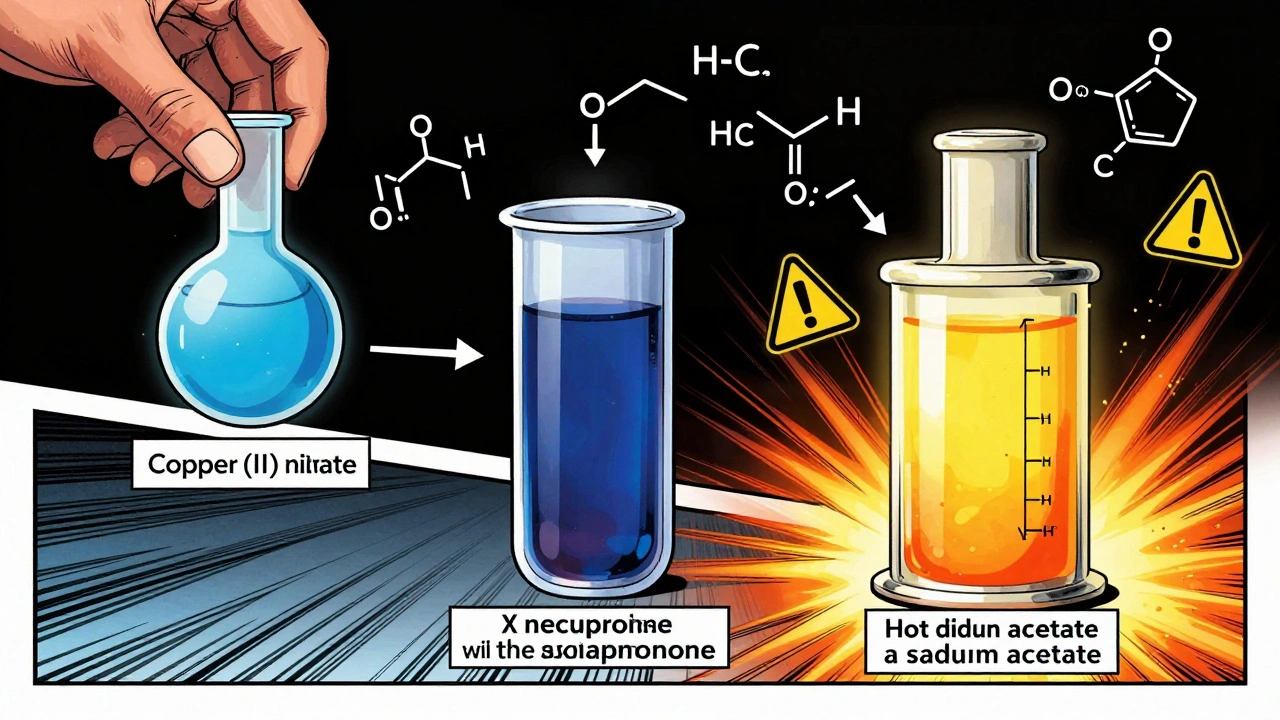
Testing Synthetic Cathinones - The Bath Salts Challenge
Synthetic cathinones - drugs like mephedrone and methylone - are even harder to catch. Most standard reagents, including Marquis, give no reaction. That left officers blind. A new protocol was developed using three reagents in sequence:- Add copper(II) nitrate - turns the sample light blue.
- Add neocuproine - the color deepens.
- Add sodium acetate, then gently heat.
Why This Matters in the Field
A lab test - like gas chromatography - can take 24 to 72 hours. It costs $150 per sample. It needs trained technicians, electricity, and a controlled environment. A color reagent test? One vial. One drop. One minute. Costs less than $2. Works in a patrol car. Works in a warehouse. Works at a music festival. For border agents intercepting packages, it’s life-saving. A single shipment might contain 500 pills. Without a field test, they’d have to send every one to the lab. With color reagents? They can screen 50 in 10 minutes and isolate the dangerous ones. For harm reduction groups like DanceSafe, these tests are equally vital. People use them to check if what they bought is actually what they think it is. They’re not law enforcement. They’re trying to prevent overdoses.Limitations You Can’t Ignore
Color tests are presumptive. That means: probably, not definitely. - A positive result doesn’t prove the drug is pure. It could be mixed with fentanyl, caffeine, or chalk. - A negative result doesn’t mean it’s safe. Some drugs don’t react at all. - Reagents can degrade if stored in heat or sunlight. A vial left in a hot car might give false negatives. - Cross-reactivity is real. Liebermann’s can react with both LSD and synthetic cannabinoids. You need multiple tests to be sure. That’s why every field test is followed by lab confirmation. But the field test? It’s the first filter. It tells you where to look.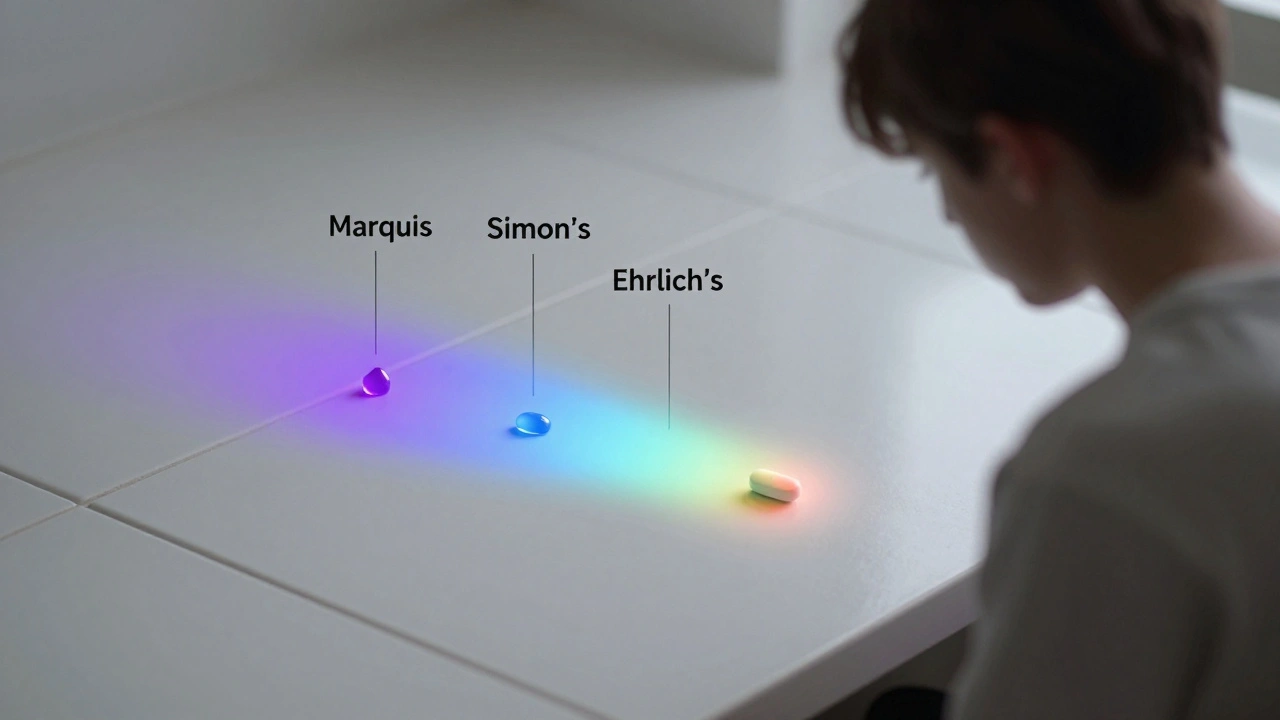
What’s Next?
New psychoactive substances (NPS) are being made faster than tests can be built. Every year, 50-100 new drugs appear. Most have no field test yet. Researchers are now working on tests for:- New synthetic opioids (like isotonitazene)
- Novel benzodiazepines (like etizolam analogs)
- Psychedelic tryptamines (like 4-HO-MET)
How to Use These Tests Safely
If you’re not law enforcement - say, you’re at a festival and want to test a pill - here’s how to do it right:- Use a clean surface. A white ceramic tile or spot plate works best.
- Use a tiny amount. A grain of sand-sized piece is enough.
- Use multiple reagents. One test isn’t enough. Always check with Marquis, Simon’s, and Ehrlich’s.
- Compare to a color chart. Don’t guess. Match the shade exactly.
- Don’t trust a single result. If it’s unclear, don’t use it.
Final Thoughts
Color reagent tests aren’t glamorous. They don’t make headlines. But they’re one of the most effective tools we have for stopping drug-related harm before it happens. They’re fast. They’re cheap. They’re simple. And they’re saving lives every day - not just in police stations, but in homes, clubs, and hospitals. The science is evolving. The tools are improving. And the people using them? They’re learning faster than ever.Are color reagent tests legally admissible in court?
No. Color reagent tests are considered presumptive only. They can justify further investigation or arrest, but they cannot be used as standalone evidence in court. Confirmatory tests like gas chromatography or mass spectrometry are required for legal prosecution. However, field test results are often used to guide lab priorities - for example, if a reagent test flags a substance as fentanyl, the lab will prioritize that sample.
Can I buy color reagent tests as a private citizen?
Yes, in most U.S. states and many countries, you can legally purchase reagent test kits from harm reduction organizations like DanceSafe, Bunk Police, or Bunk Beds. These are marketed for personal safety, not law enforcement. However, using them to test drugs you intend to consume may still carry legal risks depending on local drug laws. Always check your local regulations.
How long do reagent test kits last?
Most reagents last 1-3 years if stored properly - in a cool, dark place, away from heat and moisture. Exposure to sunlight or temperatures above 80°F (27°C) can break down the chemicals. Always check the expiration date on the vial. If the liquid looks cloudy, smells odd, or has changed color on its own, don’t use it. Old reagents can give false negatives, which is dangerous.
Why doesn’t Marquis reagent work on bath salts?
Marquis reagent detects amphetamines and opioids by reacting with their specific molecular structures - mainly the amine group and aromatic rings. Synthetic cathinones (bath salts) have a different chemical backbone. Their structure doesn’t trigger the same reaction. That’s why they often appear as negative on Marquis tests, even though they’re potent drugs. This gap led to the development of the three-reagent cathinone test, which specifically targets their electron-rich structure.
Can a color test detect fentanyl?
Standard reagents like Marquis or Simon’s do not reliably detect fentanyl. Fentanyl doesn’t produce a strong color change with common reagents. However, specialized fentanyl test strips - which are different from color reagents - are now widely available. These strips use immunoassay technology and change color when fentanyl is present. They’re more sensitive than color reagents for this specific drug. Some newer reagent kits now include a fentanyl-specific reagent, but they’re still rare in standard field kits.