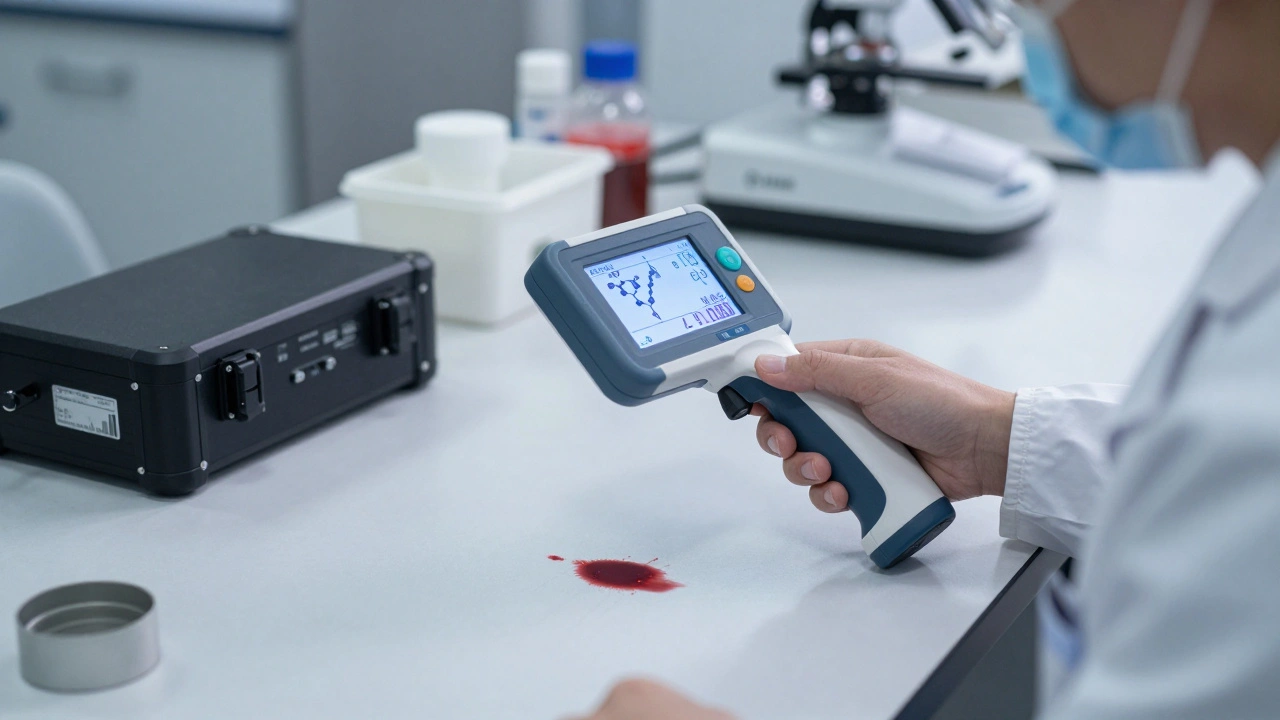
Forensic labs aren't what they used to be. Ten years ago, a bloodstain on a kitchen floor might have taken weeks to analyze. Now, a technician can scan it with a handheld device in minutes and get a result that tells not just what it is, but how old it is. This isn't science fiction-it’s happening in accredited labs across the country right now. The expansion of forensic methods isn’t just about adding new tools. It’s about changing how evidence is collected, interpreted, and used in court. And for labs seeking or maintaining accreditation, this shift isn’t optional-it’s essential.
From Lab Bench to Crime Scene: The Rise of Portable Analysis
Before, every piece of evidence had to be boxed, labeled, and shipped to a central lab. That meant delays. It meant degradation. It meant lost context. Today, portable spectroscopy tools are changing that. Devices using Raman spectroscopy and a technique that identifies molecular vibrations using laser light, allowing non-destructive identification of substances like drugs and explosives fit in a backpack. Field teams now carry them to crime scenes to instantly identify white powders, illicit pills, or even trace gunshot residue on clothing. No more waiting for a lab report to confirm what’s in a baggie.
Even more powerful is laser-induced breakdown spectroscopy (LIBS) a method that vaporizes a tiny portion of a sample with a laser and analyzes the emitted light to determine elemental composition. It’s being used to analyze paint chips from hit-and-run accidents, soil from shoe prints, and even the metal residue on bullets. One lab in Ohio used LIBS to match a paint fragment to a specific model of a 2021 Honda Civic-something that would have required sending samples to a specialized facility months ago.
Breaking the Limits of DNA Analysis
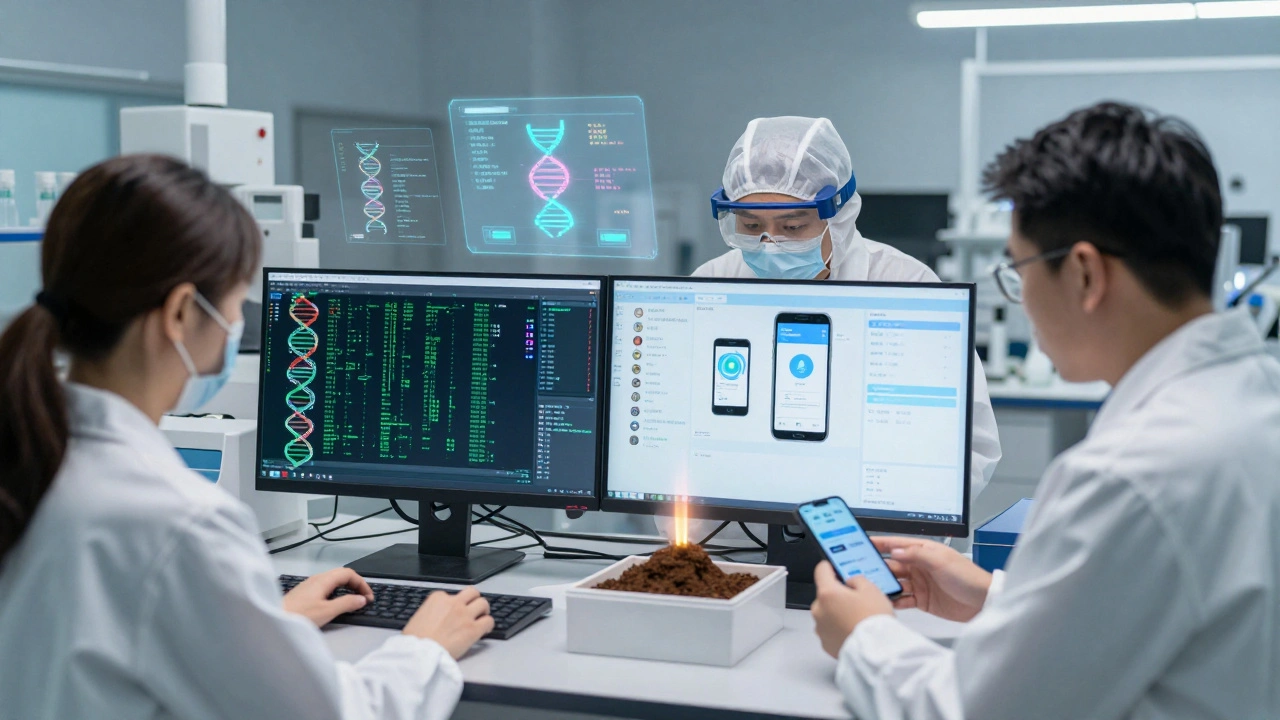
DNA used to mean a single profile: a 13-locus STR analysis. Today, labs are using next-generation sequencing (NGS) a high-throughput DNA analysis method that reads millions of DNA fragments simultaneously, enabling detailed profiling and mixed sample resolution to get far more information. NGS can now identify not just who left the DNA, but potentially where they’ve been, what they’ve eaten, or even their ancestry. It’s also helping solve cases with mixed samples-like a shirt with DNA from three people-where older methods failed completely.
And it’s not just about human DNA. environmental DNA (eDNA) genetic material collected from environmental samples like soil, water, or air, used to detect the presence of organisms without direct observation is being tested to identify trace biological material at crime scenes-like a dog’s saliva on a stolen bike, or a bird’s feather caught on a fence near a body. These aren’t lab curiosities anymore. Accredited labs in California and Texas are already validating these methods for casework.
AI and Machine Learning: The Silent Analyst
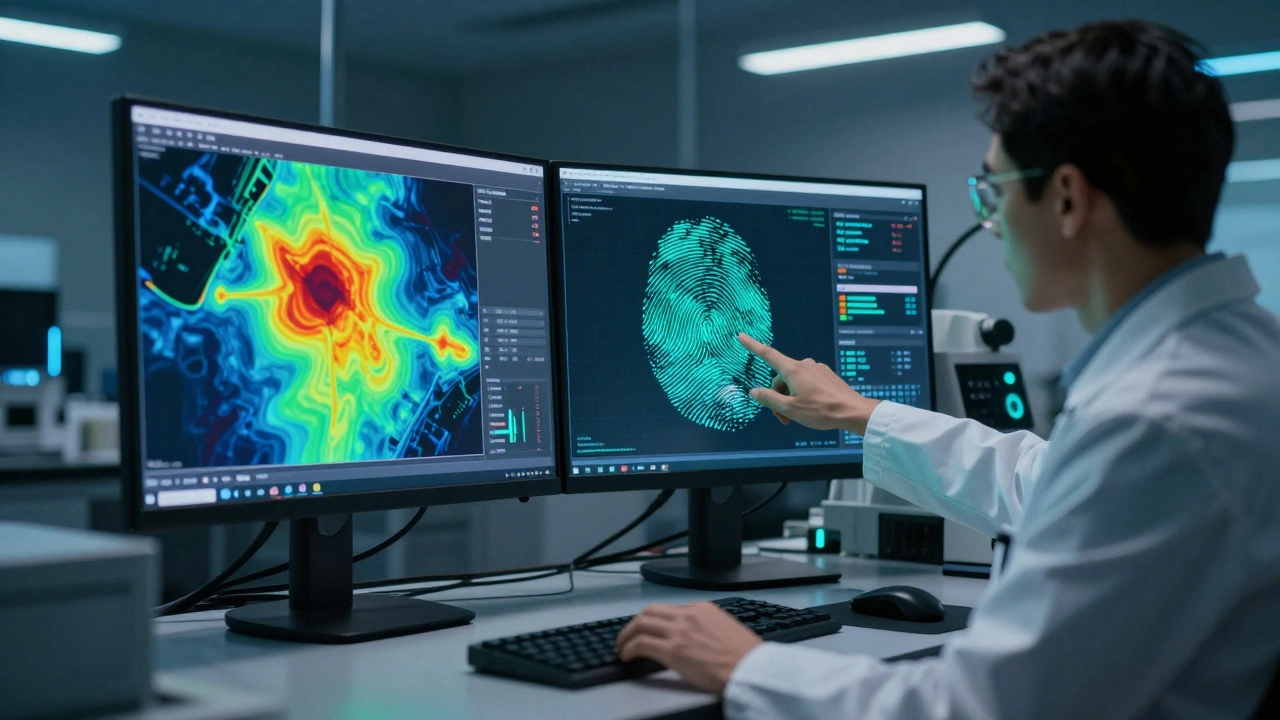
Imagine sorting through 12,000 surveillance clips from a single neighborhood. A human analyst might take months. An AI system can flag suspicious activity in hours. That’s not hypothetical-it’s happening. Labs are now using machine learning algorithms computational systems that learn patterns from data to make predictions or classifications without explicit programming to analyze fingerprints, match voice recordings, and even interpret bloodstain patterns.
One study from the National Institute of Justice showed AI correctly identified suspect fingerprints in 92% of cases where human analysts disagreed. Another tool, trained on thousands of arson fire patterns, now helps determine whether a fire was intentionally set by comparing heat distribution and burn patterns against a database of verified cases. These aren’t replacing examiners. They’re giving them superpowers-faster, more consistent, and less biased decisions.
Digital Forensics: The New Frontier
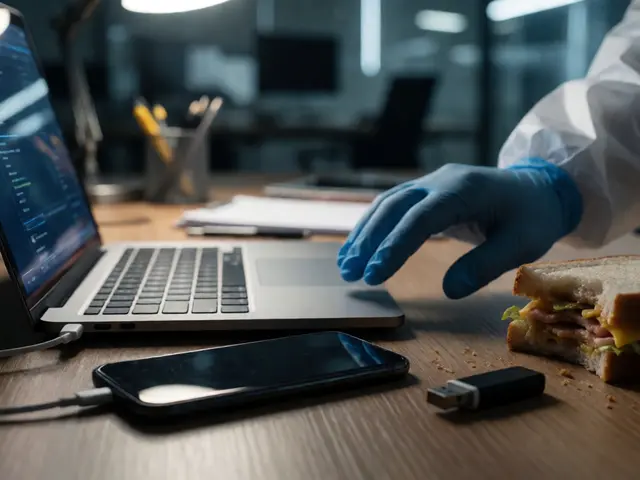
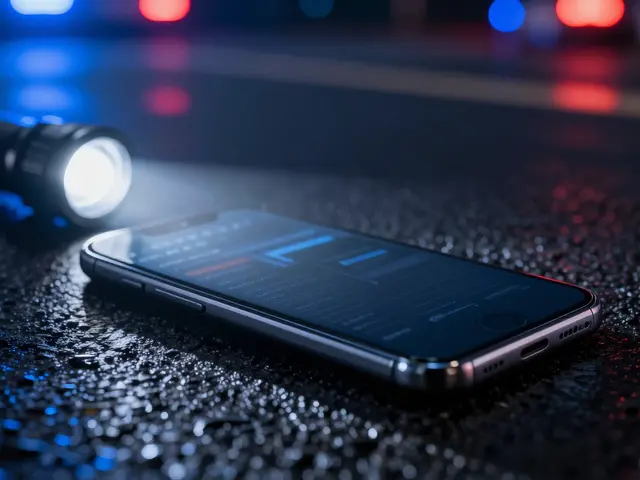
Today’s evidence isn’t just in vials and envelopes. It’s in phones, smartwatches, cloud storage, and even smart home devices. Digital forensics has exploded beyond simple file recovery. Modern labs now use multimodal location analysis a technique that combines GPS, Wi-Fi, Bluetooth, and cell tower data to reconstruct a device’s movement over time with high precision to track suspects’ movements across days or weeks. In a 2025 homicide case in Portland, investigators used data from a victim’s fitness tracker, her husband’s smart thermostat, and nearby traffic cameras to reconstruct the timeline of the crime to within 47 seconds.
And with deepfakes becoming more common, labs are now using digital authenticity verification techniques that use cryptographic hashing and metadata analysis to confirm whether digital files have been altered or fabricated. This isn’t just about recovering data-it’s about proving it hasn’t been tampered with. Courts are starting to accept this as evidence. Accreditation bodies now require labs to have validated protocols for this kind of analysis.
Timing Evidence: How Old Is That Bloodstain?
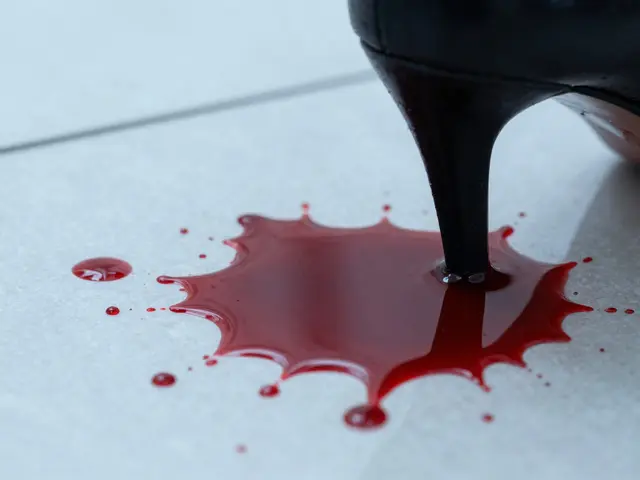
For decades, forensic science couldn’t answer a simple question: when was this blood left here? Now, it can. Using attenuated total reflectance Fourier transform infrared (ATR FT-IR) spectroscopy a technique that measures how infrared light interacts with a sample’s molecular bonds, allowing identification of chemical composition without destroying the sample combined with chemometrics, labs can now estimate the age of a bloodstain with up to 90% accuracy for up to 212 days. This isn’t guesswork-it’s a statistical model trained on over 3,000 real samples. In a domestic violence case in Oregon, this method helped prove the victim’s injuries occurred hours before the call, not days earlier as the suspect claimed.
Why Accreditation Matters Now More Than Ever
Adding new methods isn’t just about buying fancy equipment. Accreditation bodies like ISO/IEC 17025 now require labs to prove they can validate every new technique. That means:
- Documenting every step of the process-from sample prep to data interpretation
- Validating accuracy, precision, and limits of detection for each method
- Training staff not just to operate machines, but to understand the underlying science
- Implementing quality control checks that match the complexity of the new tools
One lab in Minnesota lost its accreditation after using a new AI tool without validating its error rate. The court threw out three cases. The lesson? New methods bring new risks. Accreditation isn’t a checkbox. It’s the foundation that keeps forensic science trustworthy.
The Challenges: Cost, Training, and Ethics
None of this comes cheap. A single portable LIBS unit costs over $40,000. NGS platforms run $500,000. AI systems need ongoing training data and cloud computing power. Smaller labs struggle to keep up. And training? You can’t just hand someone a tablet and expect them to interpret a microbiome profile. You need chemists, data scientists, and forensic analysts working together.
Then there’s ethics. AI can be biased. If an algorithm is trained mostly on data from urban areas, it might misclassify evidence from rural crimes. Who owns DNA collected from a public space? What happens when a digital tool makes a mistake? These aren’t theoretical concerns-they’re already showing up in court challenges.
Where This Is All Heading
By 2027, we’ll likely see labs that combine all these methods in one workflow: a technician collects a sample at a scene, runs a portable Raman scan, logs the location with GPS, sends the data to a cloud server where AI cross-references it with a national database, and returns a preliminary report within 20 minutes. The lab then confirms it with NGS and ATR FT-IR. This isn’t a fantasy. It’s the direction every accredited lab is moving.
The goal isn’t just speed. It’s reliability. It’s fairness. It’s ensuring that justice isn’t delayed by outdated methods. The expansion of forensic science isn’t about gadgets. It’s about restoring public trust in evidence-and that starts with labs that are ready to evolve.
Can small forensic labs afford these new methods?
Yes, but it requires strategic partnerships. Many smaller labs now share equipment through regional consortia or use grant funding from the National Institute of Justice. Some methods, like portable Raman or smartphone-based image analysis, cost under $5,000. The key isn’t buying everything at once-it’s prioritizing methods that solve the most common cases in your area, then scaling up as funding allows.
How long does it take to validate a new forensic method for accreditation?
Validation typically takes 6 to 18 months, depending on complexity. Labs must collect hundreds of samples, run repeated tests, document error rates, and submit peer-reviewed data. For example, validating a bloodstain aging algorithm required over 2,000 controlled samples and three independent lab validations before it was accepted by an accreditation body.
Are AI-generated conclusions admissible in court?
Not on their own. Courts require human oversight. AI tools are treated as decision-support systems, not autonomous experts. The forensic examiner must explain how the tool was used, its limitations, and why they agree or disagree with its output. In 2024, a federal appeals court ruled that AI-generated fingerprint matches were inadmissible unless the examiner provided a full validation record and testified to their independent review.
What’s the biggest risk in adopting new forensic methods?
The biggest risk is skipping validation. Labs that rush to use new tools without proper testing risk false positives, wrongful convictions, and loss of accreditation. One lab in Texas used a new AI facial recognition tool without validating it against diverse populations. It misidentified 38% of Black suspects. The case collapsed. The lab was suspended. Validation isn’t bureaucracy-it’s justice.
Do I need a data scientist on staff to use AI in forensics?
Not necessarily. Many forensic AI tools now come with user-friendly interfaces and pre-trained models. What you do need is someone who understands both the forensic question and the tool’s output. A DNA analyst who can interpret an NGS report, or a fingerprint examiner who can question an AI match, is more valuable than a data scientist who doesn’t know how a bloodstain forms.
Forensic science is no longer confined to glassware and microscopes. The future belongs to labs that embrace change-not just with new machines, but with new thinking. Accreditation isn’t about keeping up. It’s about leading the way.