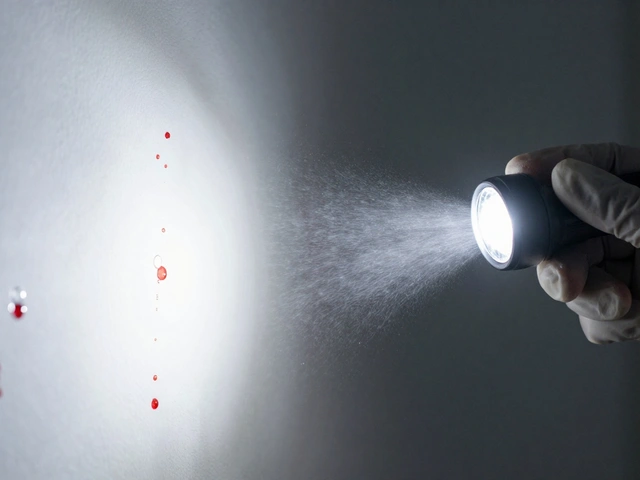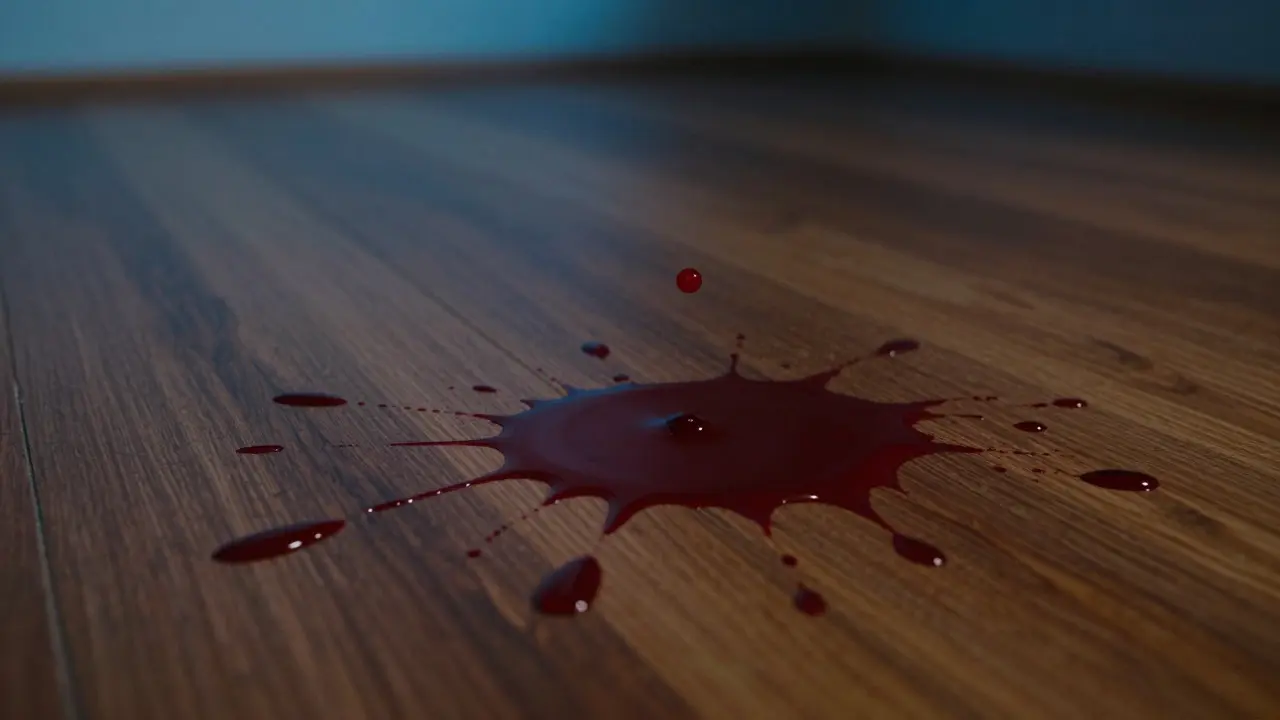
Imagine walking into a room where the only witness is a splash of red on the floor. It looks random, but to a trained eye, it tells a story about force, angle, and direction. Bloodstain Pattern Analysis is the scientific discipline used to interpret the location, size, shape, and distribution of bloodstains to reconstruct events at a crime scene. It doesn't just tell you what happened; it helps you understand how it happened. For investigators, this isn't magic-it's physics applied to biology. If you get the math right, the stains will confess the truth about the weapon, the victim's position, and even the number of blows struck.
Key Takeaways
- Bloodstain Pattern Analysis relies on fundamental physics principles like gravity and surface tension to determine event sequences.
- Distinguishing between passive drops, impact spatters, and projected patterns is the first critical step in any reconstruction.
- Angle of impact calculations require precise measurement of stain dimensions (width and length) to locate the area of convergence.
- Modern BPA integrates with DNA profiling to link specific stains to individuals, but pattern analysis remains distinct from genetic identification.
- Documentation must be exhaustive; a single missed drop can alter the entire narrative of the case.
The Physics Behind the Stains
Before you touch a ruler or take a photo, you need to understand why blood behaves the way it does. Blood is not water. It has viscosity, surface tension, and coagulation factors that change its behavior depending on the environment. When a drop falls, gravity pulls it down, but air resistance shapes its path. The moment it hits a surface, the kinetic energy determines the result. A low-velocity impact produces a round drop. A high-velocity impact shatters the drop into tiny mist-like particles.
This behavior is governed by Newton’s laws. Specifically, the angle at which a drop strikes a surface dictates its elliptical shape. A drop hitting perpendicular to a surface creates a circular stain. As the angle decreases, the stain stretches into an ellipse. This relationship is consistent and predictable, forming the backbone of geometric reconstruction in forensics.
Classifying the Patterns
Not all stains are created equal. You generally categorize them into three main groups based on the energy involved. Getting these right prevents early errors in your report.
- Passive Patterns: These occur when blood falls under the influence of gravity alone. Think of a dripping wound or a pool forming under a body. These are usually larger, rounder drops. They indicate the source was stationary or moving slowly.
- Impact Spatter: This happens when an object strikes a blood-bearing surface. The energy of the strike breaks the blood into droplets. Low-velocity impact (like a punch) creates larger drops. Medium-velocity (like a baseball bat) creates smaller ones. High-velocity (like a gunshot) creates fine mist.
- Projected Patterns: These involve blood being pushed or sprayed out of a vessel. Arterial spurts create rhythmic, linear patterns due to pulsation. Expirational smears happen when a victim breathes out blood through the nose or mouth.
Calculating the Angle of Impact
This is where the math gets real. To find the angle of impact, you measure the width ($W$) and length ($L$) of an elliptical stain. The formula is straightforward: $\sin(\theta) = W / L$. Once you have the sine value, you use a calculator or trigonometric table to find the angle ($\theta$).
Let’s say you measure a stain that is 1 cm wide and 4 cm long. Your calculation is $\sin(\theta) = 1/4 = 0.25$. The arcsine of 0.25 is approximately 14.5 degrees. This means the blood hit the surface at a shallow 14.5-degree angle. Repeat this for several stains in a cluster, and you can triangulate the point of origin in 3D space.
| Velocity Type | Typical Source | Avg Drop Diameter | Pattern Appearance |
|---|---|---|---|
| Low Velocity | Blunt Force Trauma | > 4 mm | Satellite spatter around large central drops |
| Medium Velocity | Beating, Bat Strike | 1 - 4 mm | Radiating spatter, directional tails |
| High Velocity | Gunshot, Rotating Blade | < 1 mm | Fine mist, extensive coverage, back-spatter |
Reconstructing the Scene
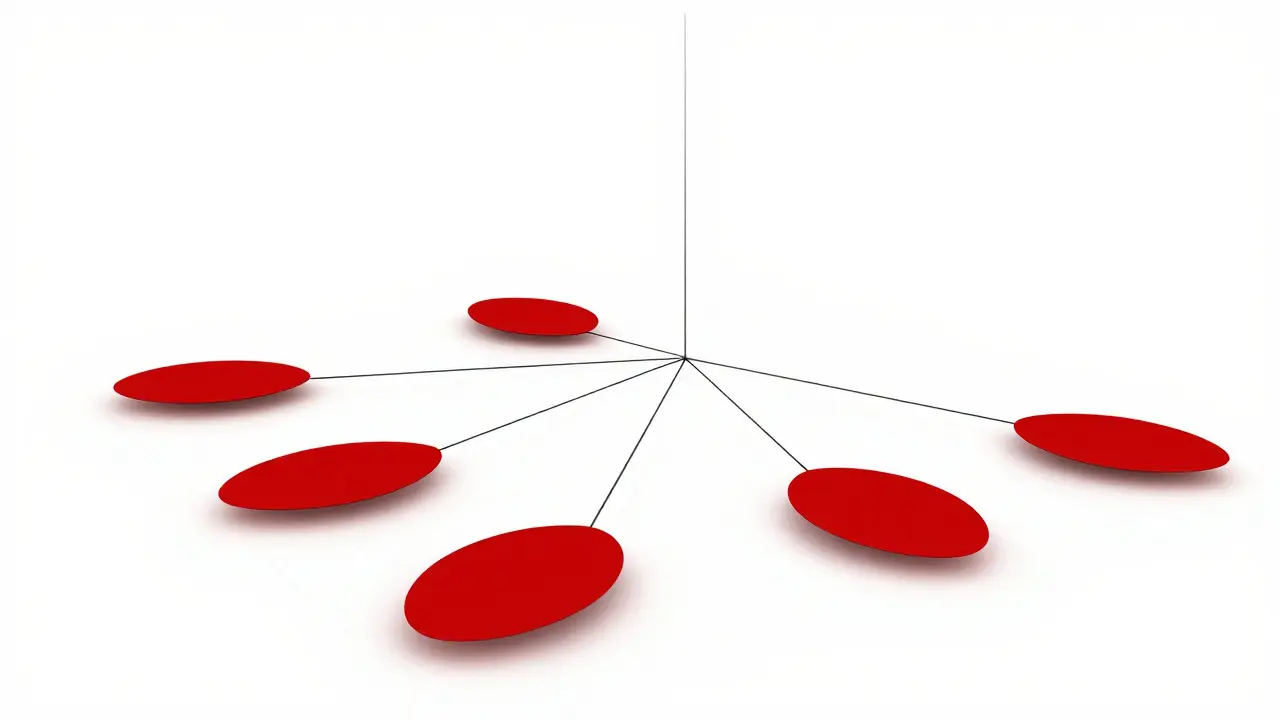
Once you have your angles, you extend lines backward from the tail of each stain. Where these lines intersect is the Area of Convergence. By combining this with the height calculated from the angle, you pinpoint the Point of Origin. This tells you where the blood source was relative to the stain.
Consider a scenario involving multiple wounds. If the point of origin for the first set of stains is near the head, and the second set is lower, you might infer the victim moved or was dragged after the initial injury. Directional drag stains can further confirm movement. The tail of a drag stain points in the direction of travel, while the head is rounded. This simple visual cue can distinguish a fall from a drag.
Documentation and Pitfalls
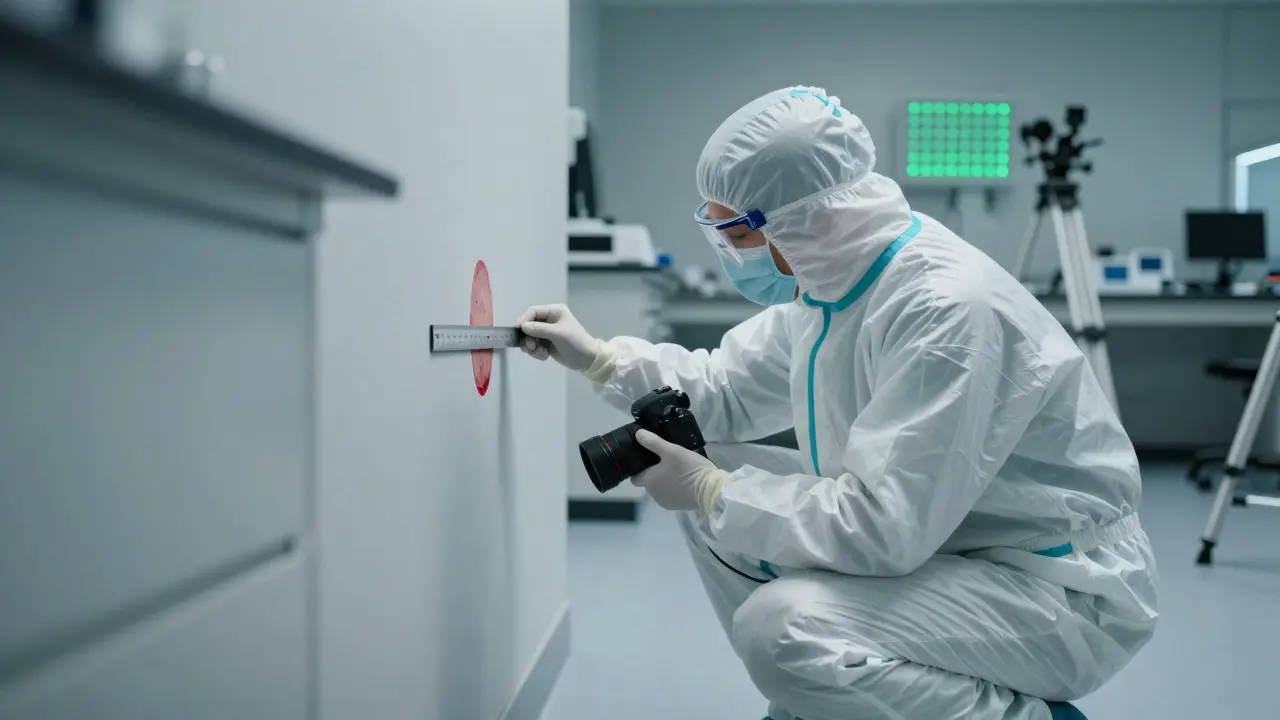
The most common mistake in BPA is poor documentation. If you don’t photograph the scene with scale bars and reference objects, your measurements are useless later. Always use orthogonal photography-shooting straight down or parallel to the surface-to avoid distortion. Use a laser grid if available to map coordinates accurately.
Avoid touching stains before documenting them. Smudging destroys the edges needed for angle calculation. Also, be wary of environmental factors. Rain, cleaning attempts, or even insects can alter patterns. Note any anomalies immediately. A stain that looks like spatter might actually be paint or rust if the color spectrum is off. Confirming it is blood using presumptive tests like Kastle-Meyer or luminol is a prerequisite, not an afterthought.
Integration with Other Forensic Disciplines
BPA doesn't work in isolation. It connects deeply with DNA Profiling, which identifies who left the blood, but not necessarily how. While DNA says "John Doe's blood is here," BPA says "John Doe was standing there when he was hit." Combining these gives a complete picture. It also links to Ballistics; the caliber of a bullet affects the amount of back-spatter. A .22 caliber round produces less spatter than a .45 caliber, which helps match the weapon to the pattern.
Furthermore, understanding Toxicology can explain unusual clotting times or bleeding rates, which affect the volume and spread of stains. If a victim was on anticoagulants, their blood would flow more freely, creating larger pools than expected. Context is everything.
Mini-FAQ
Can bloodstain patterns identify the weapon?
Indirectly, yes. The velocity and distribution of spatter can suggest the type of force used. For example, a rotating blade creates a different mist pattern than a static knife thrust. However, it rarely identifies the specific serial number of a weapon, but it can rule out incompatible tools.
How accurate is the angle of impact calculation?
It is highly accurate if the stain is intact and measured correctly. Errors usually come from measuring distorted stains or failing to account for surface texture. Smooth surfaces yield better results than porous ones like carpet, which absorbs the center of the drop and distorts the shape.
What is the difference between spatter and spray?
Spatter is caused by external force striking blood. Spray is often associated with pressure, such as arterial pumping or expiratory breathing. Spatter tends to radiate outward from a point, while spray may follow a trajectory determined by the source's orientation and pressure cycles.
Do I need special software for BPA?
No, though software helps. Basic trigonometry and graph paper work well for simple scenes. For complex 3D reconstructions, digital tools allow you to overlay photos and calculate intersections faster, reducing human error in manual plotting.
How long does it take to analyze a scene?
It varies. A simple passive drip scene might take an hour to document and calculate. A complex multi-wound scene with hundreds of stains could take days to weeks for full reconstruction and report writing. Time depends on the number of measurable stains and the complexity of the geometry.