Accreditation isn’t something you get once and forget. If you’re running a lab, a training program, or any conformity assessment body, your accreditation is a living agreement - not a trophy on the wall. It demands constant attention, regular checks, and timely renewals. Skip a surveillance visit? Miss a renewal deadline? Your accreditation can vanish overnight, taking your credibility, contracts, and revenue with it.
Why Surveillance Isn’t Optional
Think of surveillance as a routine health check for your lab’s quality system. It’s not about catching you doing something wrong. It’s about proving you’re doing everything right - consistently. Accrediting bodies like ALGERAC require these visits because standards don’t stay still. New methods emerge. Regulations change. Equipment gets outdated. Your processes must evolve, or you’re no longer compliant.Surveillance isn’t a surprise inspection. It’s scheduled. But the schedule is strict. For example, under ALGERAC’s three-year cycle, the first surveillance visit must happen no later than 14 months after initial accreditation. The second? No later than 24 months. Miss either window by even a few days, and you risk suspension. There’s no grace period unless you have a documented, approved reason - and even then, it’s temporary.
What happens during surveillance? Assessors don’t just look at your certificates. They dig into your records: internal audit logs, management review minutes, staff training files, equipment calibration histories. They check if your corrective actions actually fixed the problems from last time. They verify that your quality manual reflects what’s happening on the floor - not just what was written two years ago. If your documentation is sloppy or incomplete, you’ll fail. Sixty-four percent of compliance failures come down to poor recordkeeping. That’s not a statistic - it’s a warning.
The Two Main Renewal Cycles
Not all accreditation cycles are the same. The length and frequency depend entirely on who’s doing the accrediting. ALGERAC offers two distinct models:- Three-year cycle: Initial accreditation lasts three years. Surveillance visits happen every 12 months. After three years, you must apply for renewal.
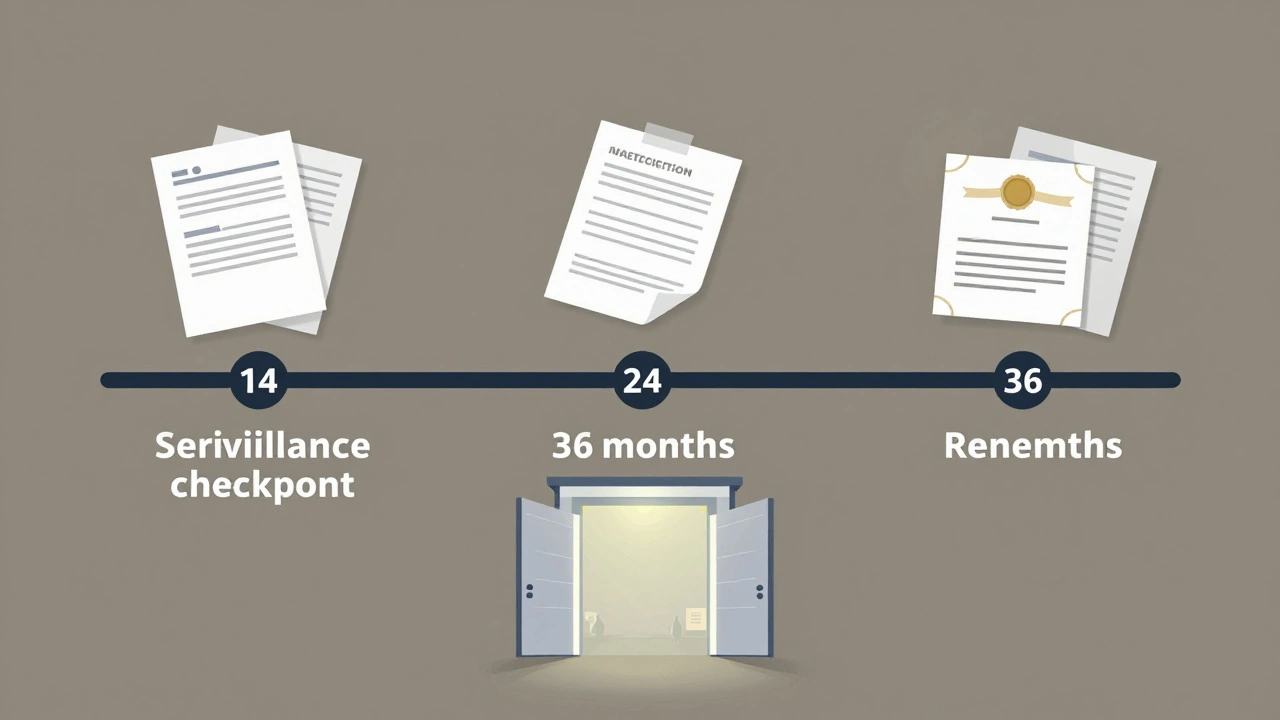
- Four-year cycle: Available after successful renewal. This longer cycle includes three surveillance visits - at 14, 26, and 36 months. It’s designed for organizations with proven, stable systems.
Other bodies have different rules. IACET, for example, uses a five-year cycle. You must submit your renewal application at least 90 days before expiration. The fee? $4,370 - split between application review and maintenance. ACRP requires you to earn 24 points over two years through continuing education or by retaking the certification exam. Miss the deadline? Your credential lapses. No second chances.
The key takeaway? Know your accreditor’s rules. Don’t assume your cycle matches someone else’s. If you’re unsure, call them. Email them. Don’t wait for a reminder - many organizations don’t send them until it’s too late.
Renewal: More Than Just a Form
Renewal isn’t a box to check. It’s a full audit of your entire operation over the past cycle. You’ll need to submit:- Updated quality manual and procedures
- Proof of all surveillance compliance
- Records of staff training and competency assessments
- Internal audit reports and corrective action logs
- Documentation of any changes in scope, personnel, or location
ALGERAC requires renewal files to be submitted per DOC 02, Article 05. If your file arrives after your certificate expires, your renewal is treated as a new accreditation. That means a new number - even if you’re the same lab with the same team. You lose continuity. Your clients may question your stability. Your reputation takes a hit.
And here’s the catch: renewal processing can take months. If you wait until the last minute, you’re gambling with your accreditation. Industry data shows that organizations that start renewal planning six months ahead have a 90% success rate. Those who wait until the final quarter? Less than 50%.
Building a Maintenance System That Works
You can’t rely on memory, sticky notes, or a single calendar. You need a system. A real one.Start with a Master Calendar. List every accreditation you hold - lab, personnel, equipment. Note:
- Expiration date
- Surveillance deadlines
- Renewal application due date
- Internal audit due dates
- Staff training completion windows
Then work backward. If your renewal is due in January 2027, when do you need to start gathering documents? When do your audits need to be done? When must training be completed? Set reminders 6, 3, and 1 months out. Use calendar alerts. Use email triggers. Use a shared team drive.
Track continuing education like a financial ledger. Don’t just count hours. Record:
- Course title
- Provider name
- Completion date
- Certificate number
- How it aligns with accreditation requirements
Store copies everywhere. Cloud storage. Email attachments. Printed files in a locked cabinet. If your hard drive crashes or your office floods, you still have proof. One lab lost its entire documentation set to a server failure. They couldn’t prove they’d done their last surveillance audit. Accreditation was suspended for six months. The cost? Over $120,000 in lost contracts.

What Happens When You Fail
Failing surveillance doesn’t mean you’re done forever. But it does mean you’re in crisis mode.If you miss a surveillance visit, you’ll get a notice. You’ll have 30 to 60 days to explain why and submit corrective actions. If you don’t respond - or if your response is weak - your accreditation is suspended. You can’t claim to be accredited. You can’t use the logo. You can’t bid on contracts that require it.
Reinstatement is possible, but it’s expensive. You’ll need to pay a reinstatement fee, undergo a full reassessment, and prove you’ve fixed every issue. The average time to regain full compliance after a lapse? Six months. During that time, your staff is idle. Your clients are gone. Your reputation is damaged.
And if you miss a renewal deadline? Your accreditation expires. Period. No grace. No extension. To get it back, you apply as a new applicant. That means a new application fee, a new assessment, a new waiting period. You lose your old number. You lose your history. You start from scratch.
Pro Tips to Stay Ahead
- Don’t wait for emails. Accreditors send reminders - but they’re not always accurate. Check your deadlines yourself.
- Assign ownership. Who in your lab is responsible for tracking renewals? Make it one person - and have a backup.
- Review standards yearly. Accreditation requirements change. Read the latest version. Don’t rely on last year’s manual.
- Do mock audits. Every six months, run an internal simulation of a surveillance visit. Find your gaps before the assessor does.
- Build relationships. Talk to your accreditor. Ask questions. Attend their webinars. Know their priorities.
Accreditation maintenance isn’t paperwork. It’s insurance. It’s your license to operate. It’s your proof that you’re not just meeting standards - you’re living them. The best labs don’t just survive surveillance. They welcome it. Because they know: if you’re ready, it’s not a threat. It’s validation.
What happens if I miss a surveillance visit deadline?
Missing a surveillance deadline typically triggers an immediate suspension of your accreditation. You’ll receive a formal notice and may be given a short window - usually 30 to 60 days - to explain the delay and submit corrective actions. If your response is inadequate or you don’t respond at all, your accreditation is suspended. You cannot operate as an accredited facility during suspension, and reinstatement requires a full reassessment, additional fees, and proof of long-term compliance.
How often do surveillance visits occur?
The frequency depends on your accreditor and cycle length. ALGERAC requires annual visits for its three-year cycle and three visits over four years for the extended cycle. Other bodies like IACET and CALEA also require annual reviews. Most accreditation programs schedule surveillance every 12 months, with some allowing biannual visits after several successful cycles. Always check your specific agreement - deadlines are non-negotiable.
Can I renew my accreditation early?
Yes, you can - and you should. Most accrediting bodies allow you to submit renewal applications up to six months before expiration. Starting early gives you time to fix gaps, gather documentation, and avoid last-minute surprises. If you renew early, your new certificate will still begin on the day your old one expires. There’s no penalty for early submission - only benefits.
Do I need to retrain my entire staff for renewal?
No, you don’t need to retrain everyone. But you must show that all personnel have completed required competency assessments and continuing education within the renewal period. For example, ACRP requires 24 points from education and involvement activities over two years. You must document each person’s training, including course titles, dates, and how it aligns with accreditation standards. The focus is on ongoing development, not mass retraining.
What documents are most critical for renewal?
The most critical documents are: your quality manual (updated to current standards), internal audit reports, management review minutes, staff competency records, equipment calibration logs, corrective action records from surveillance visits, and proof of continuing education. Missing even one of these can delay or derail your renewal. Keep digital and physical backups - and organize them by date and category.