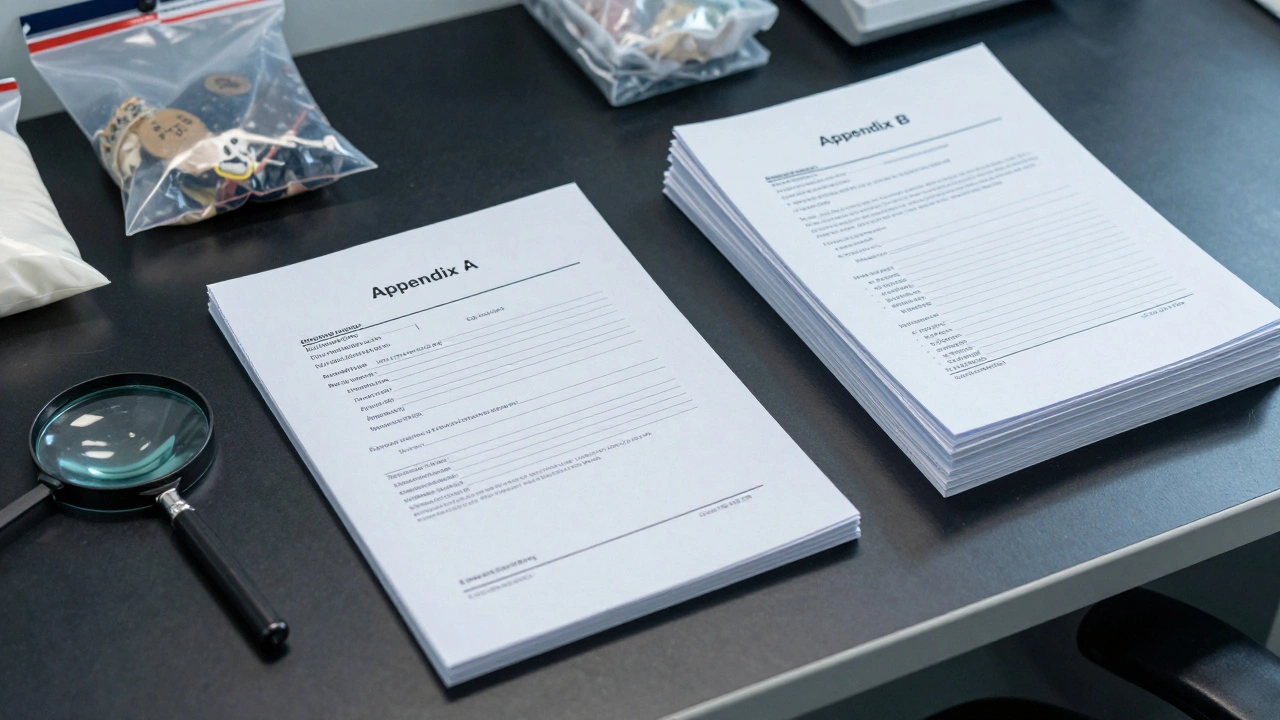
You've spent weeks analyzing evidence, running tests, and drafting your findings. Now comes the part that often feels like a chore: the appendix. If you dump every chart and photo into the back of your report without a system, you're not just making it hard for the reader-you're creating a vulnerability that an opposing attorney can exploit during cross-examination. A messy appendix suggests a messy investigation.
The goal of appendix organization is the systematic arrangement of supplementary materials that support a primary report without cluttering the main narrative. In forensic reporting, this means keeping the "story" of your evidence clear in the body text while providing a bulletproof trail of raw data, exhibits, and detailed charts in the back.
What Actually Belongs in an Appendix?
A common mistake is putting too much-or too little-in the appendix. If a piece of information is critical to your primary conclusion, it belongs in the main body. If it's something that proves your work is valid but would distract the reader if placed in the middle of a paragraph, move it to the back.
In a forensic context, you should consider the following for your appendix:
- Full Interview Transcripts: Quote the most impactful lines in your report, but put the full, unedited transcript in the appendix to avoid accusations of cherry-picking.
- Detailed Statistical Data: If you have a massive spreadsheet of chemical concentrations or digital log timestamps, a summary table goes in the body, and the full raw data set goes in the appendix.
- Equipment Specifications: Descriptions of the complex equipment used during analysis-including serial numbers, calibration dates, and model versions-belong here.
- Questionnaires and Scales: Any standardized tests or inventories used to gather data should be included in their entirety.
- Stimulus Materials: Examples of the items shown to witnesses or participants during an experiment.
Structuring Your Appendices for Maximum Clarity
Organization isn't just about where the files go; it's about how they are labeled. Whether you are following strict APA Style is a widely used set of formatting standards established by the American Psychological Association or internal agency guidelines, consistency is your best friend.
If you only have one supplementary section, simply label it Appendix. However, most forensic reports are complex enough to require multiple sections. In that case, use capital letters: Appendix A, Appendix B, and so on. Each new appendix must start on a fresh page. This prevents the reader from getting lost and makes it much easier to flip to a specific exhibit during a courtroom presentation.
| Scenario | Label Format | Example |
|---|---|---|
| Single Appendix | Bold, Centered Title | Appendix: Equipment Logs |
| Multiple Appendices | Letter + Title | Appendix A: Witness Statements |
| Nested Tables | Letter + Sequence Number | Table A1, Table A2 |
Handling Exhibits and Charts Within the Appendix
Once you've established your appendices, you need to manage the visuals inside them. You cannot simply call every chart "Figure 1," because you likely already have a "Figure 1" in your main report. To avoid confusion, use a letter-based numbering system.
If you are in Appendix B, the first table becomes Table B1 and the first chart becomes Figure B1. This creates a clear map for the reader. If an entire appendix consists of just one single table, you don't need to label it as "Table B1"; the label Appendix B serves as the reference for the entire page.
Formatting these visuals requires a bit of discipline. Tables and figures should be aligned to the left margin and separated from the text by a double-spaced blank line. Always include a note below the visual to explain exactly what the reader is looking at and how it relates to the main conclusion. For example: "Note: Figure B2 shows the peak intensity of the sample compared to the known standard."

The Art of the "Callout"
An appendix is useless if the reader doesn't know it exists. You must "call out" your supplementary materials in the main body of your report. A callout is a direct pointer that tells the reader where to find supporting evidence.
Don't just say "see the appendix." Be specific. Use phrases like:
- "The full list of items recovered from the scene can be found in Appendix A."
- "The specific parameters for the chemical analysis are detailed in Table C3."
- "Refer to Appendix B for the complete transcript of the interview with the lead investigator."
Crucially, you must call out your appendices in the order they appear. You shouldn't mention Appendix C on page 3 and then mention Appendix A on page 10. The sequence in your text should mirror the sequence at the end of your document.
Step-by-Step Implementation Workflow
If you're staring at a pile of data and don't know where to start, follow this logical flow to clean up your reporting:
- Audit Your Content: Go through your main report. Anything that breaks the flow of your argument or takes up more than half a page (like a large chart) should be flagged for the appendix.
- Group by Category: Don't just toss everything into one bucket. Group your materials logically. Create one appendix for all your exhibits (photos, physical evidence logs), one for statistical data, and one for credentials or equipment specs.
- Sequence and Label: Assign your letters (A, B, C). Create bold, centered titles for each section.
- Number Internals: Go through each appendix and label your tables and figures sequentially (A1, A2, B1, B2).
- Insert Callouts: Re-read your main text and insert the specific references to these appendices where the evidence is mentioned.
- Final Placement: Place your appendices at the very end of the document, immediately following your reference list.
Avoiding Common Reporting Pitfalls
Even experienced forensic analysts make mistakes when organizing their back-end data. One of the biggest errors is splitting a table or figure across two pages. This makes the data harder to read and can look unprofessional. If a chart is too large, consider rotating the page to landscape orientation rather than splitting the visual.
Another trap is including "essential" information only in the appendix. If a judge or jury has to flip back and forth twenty times to understand a single point, they will lose interest or get confused. The appendix is for verification, not for instruction. The main body should be a complete story on its own; the appendix is the evidence that the story is true.
Where exactly does the appendix go in a formal report?
The appendix always appears at the end of the document. Specifically, it should follow the reference list. The standard order is: Title Page, Abstract, Main Text, References, and finally, Appendices.
What if I have a huge amount of data that would make the report 500 pages long?
In cases of extreme data volume, you can provide a summarized version in the appendix and offer the full raw data as a separate digital supplement (like a CSV file or database) referenced in the appendix. However, for court-submitted reports, ensure you follow the specific discovery rules of the jurisdiction.
Can I use different formatting for the appendix than the main report?
No. The font, spacing, and general style should remain consistent with the main body of the report. The only difference should be the labeling system (e.g., using "Table A1" instead of "Table 1").
Do I need a separate title page for each appendix?
You don't need a full title page, but each appendix must start on a new page. The label (e.g., Appendix A) and the descriptive title should be bold and centered at the top of that page.
What is the difference between an exhibit and an appendix?
An appendix is a section of your report. An exhibit is a specific item of evidence. Usually, your exhibits are housed within your appendices. For example, Appendix A might be titled "Photographic Evidence," and it contains Exhibit 1, Exhibit 2, and Exhibit 3.
Next Steps for Your Report
Depending on who is reading your report, your final steps will vary. If you are submitting this to a legal team, double-check that your callouts match the exact page numbers of the appendices. If you are submitting to a peer-review board, ensure your equipment descriptions are detailed enough for another expert to replicate your results.
If you're using Microsoft Word, take advantage of the "New Label" feature in the Captions menu. By creating a custom label for "Appendix Figure," you can automate the numbering process, which prevents the nightmare of manually renaming twenty figures when you decide to add a new one in the middle of the set.