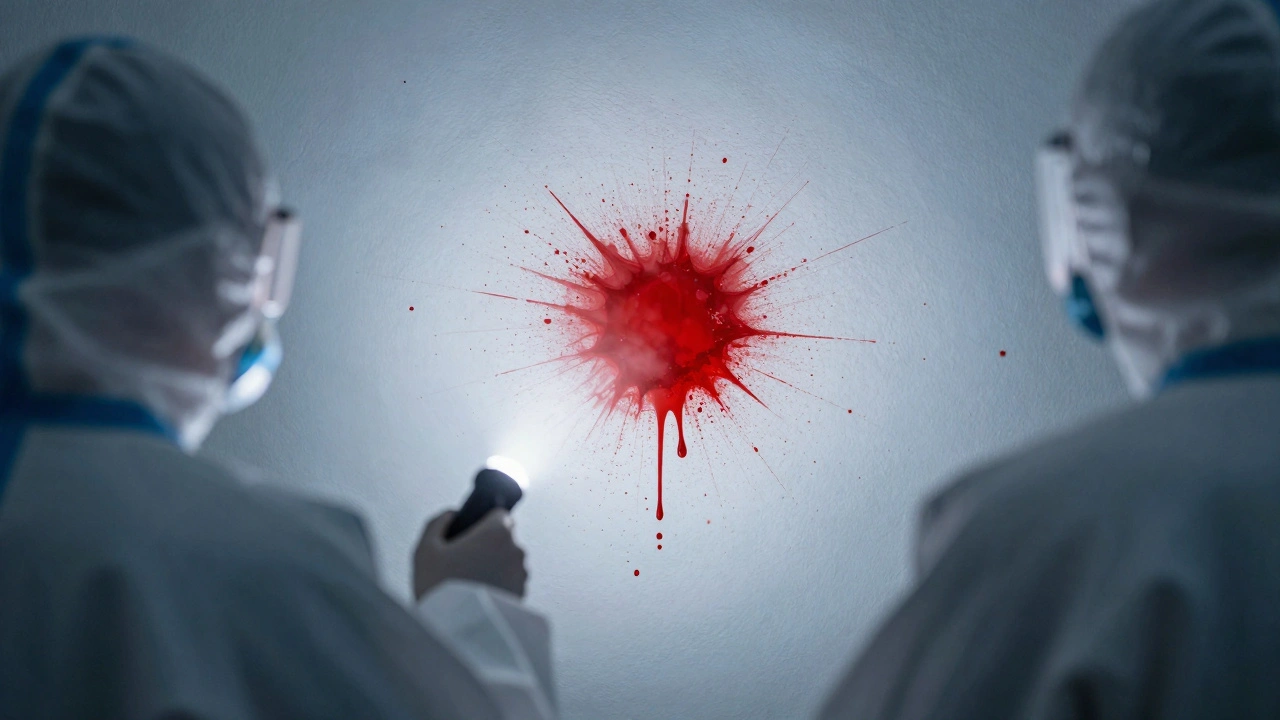
Imagine walking into a crime scene and seeing a fine, red mist coating the wall behind a victim. To the untrained eye, it looks like a spray bottle went off. To a forensic investigator, this is a critical piece of evidence known as High-Velocity Impact Spatter is a forensic phenomenon where blood and biological material are ejected from a wound at extreme speeds, creating a characteristic mist-like pattern. When a bullet hits a human body, it doesn't just make a hole; it transfers a massive amount of kinetic energy that literally atomizes blood into tiny droplets. Understanding these patterns is how investigators figure out where a shooter was standing and exactly what happened in those few violent seconds.
The Anatomy of the Mist: What Makes it High-Velocity?
Not all blood spatter is created equal. If someone is hit with a baseball bat, you get medium-velocity spatter-larger drops that look like distinct dots. But gunshot wounds are different. Because the projectile is moving so fast, it creates a "mist" of blood. These droplets are incredibly small, typically 1 millimeter or less in diameter. In some cases, especially with penetrating exit wounds, the blood is atomized down to 0.1 millimeters.
The speed is the defining factor here. These tiny droplets fly out of the body at velocities often exceeding 100 feet per second (about 30 meters per second). To put that in perspective, a .38 Special round can create an initial jet of blood moving at 20 meters per second, which slows down rapidly as it hits the air, barely moving by the time it travels half a meter. This rapid deceleration is why the "mist" is usually found very close to the point of impact.
Forward Spatter vs. Backspatter
In any shooting, the blood generally goes in two directions: with the bullet and against it. This is a foundational concept in Bloodstain Pattern Analysis, used to map the trajectory of a crime.
- Forward Spatter: This happens when the bullet exits the body. The blood is accelerated in the same direction the bullet is traveling. If you see a mist of blood on a wall and a bullet hole in that same wall, you're likely looking at forward spatter from an exit wound.
- Backspatter: This is the blood that travels back toward the shooter. It is ejected from the entry wound. While less common than forward spatter, backspatter is a goldmine for investigators because it can land on the shooter's clothing, hands, or the firearm itself, providing a direct physical link between the suspect and the victim.
| Feature | Low/Medium Velocity | High-Velocity Impact Spatter |
|---|---|---|
| Typical Cause | Blunt force, stabbing | Gunshot wounds, explosions |
| Droplet Size | Larger than 1mm | 1mm or smaller (mist-like) |
| Velocity | Under 100 ft/sec | Often over 100 ft/sec |
| Visual Appearance | Distinct drops/splashes | Atomized spray or mist |
The Science of the Wound: Cavitation and Gas
Why does a bullet create a mist while a knife doesn't? It comes down to energy transfer and the Temporary Cavity. As a bullet tears through tissue, it creates a temporary void-a cavity that expands and then collapses. This violent movement crushes tissue and forces blood and liquefied material out of the entry and exit points at high speed.
When it comes to contact wounds-where the muzzle is pressed against the skin-things get even more complex. If the bullet hits a bone, the muzzle gases from the gun are trapped. These gases can't escape easily, so they reflect off the bone and expand the subcutaneous space. This creates an explosive effect, blowing blood and soft tissue backward toward the gun, significantly increasing the amount of backspatter observed.
The type of weapon also plays a role. Research into various calibers, such as the 9mm Luger and .357 Magnum, shows that the closer the range, the more influence muzzle gases have on the pattern. The result is a heterogeneous mix of blood and gas that can be unpredictable, making it a challenge for forensic teams to analyze without secondary evidence.
The Danger of Misinterpretation
It is tempting to see a mist and immediately scream "gunshot!" However, forensic science demands a bit more caution. There is a known pitfall: high-velocity spatter can be faked by the environment. For example, if a high-pressure gas source is vented directly into a pool of blood, it can create a mist that looks exactly like a gunshot wound pattern, even if no gun was ever fired.
Interestingly, human experts are surprisingly good at telling the difference between gunshot spatter and blunt force spatter. In double-blind studies, investigators had a tiny error rate of only 0.2% when identifying gunshot patterns. But when they tried to identify blunt instrument spatter, the error rate jumped to 37%. This tells us that while gunshot patterns are very distinct, other types of spatter can easily be mistaken for one another.
Reconstructing the Scene
Putting it all together, forensic scientists use these patterns to build a narrative. By analyzing the spatial distribution of the droplets, they can estimate the position of the victim and the shooter. If forward spatter is found on a curtain and backspatter is found on a doorway, the geometry of the room starts to tell the story of the struggle.
However, these patterns aren't a "smoking gun" on their own. Because a .22 rimfire might produce different patterns than a high-caliber rifle depending on the range and angle, spatter analysis must be paired with ballistics and autopsy reports. It's one piece of a larger puzzle, providing a physical map of the energy released during the crime.
Can backspatter actually land on the shooter?
Yes, backspatter is biological material ejected back toward the firearm from the entry wound. Because it travels against the line of fire, it frequently lands on the shooter's hands, clothing, or the weapon itself, which is why forensic teams prioritize checking the suspect's gear for microscopic blood droplets.
What is the difference between high-velocity spatter and a blood spray?
A blood spray, such as arterial spurting, is caused by the heart pumping blood under pressure from a breached artery. High-velocity impact spatter is caused by an external force (like a bullet) hitting the blood source at high speed. The key difference is the droplet size; high-velocity spatter creates a much finer, atomized mist (usually under 1mm) compared to the larger drops found in arterial sprays.
Why do contact wounds cause more backspatter?
In contact wounds, muzzle gases are forced into the wound along with the bullet. If the bullet hits bone, these gases are reflected back, creating immense pressure in the subcutaneous space. This pressure essentially "explodes" the tissue and blood back out through the entry wound toward the shooter.
Is the mist pattern always a sign of a gun?
Not necessarily. While most common in gunshots, high-velocity patterns can also be caused by explosions or even non-violent occurrences, such as high-pressure gas being vented into a pool of blood. This is why forensic experts look for secondary evidence, like bullet holes or gunshot residue, to confirm the cause.
How small are the droplets in a high-velocity pattern?
Droplets are typically 1 millimeter or less in diameter. In cases of severe atomization, often associated with penetrating exit wounds, the droplets can be as small as 0.1 millimeters, creating a true mist effect on surrounding surfaces.