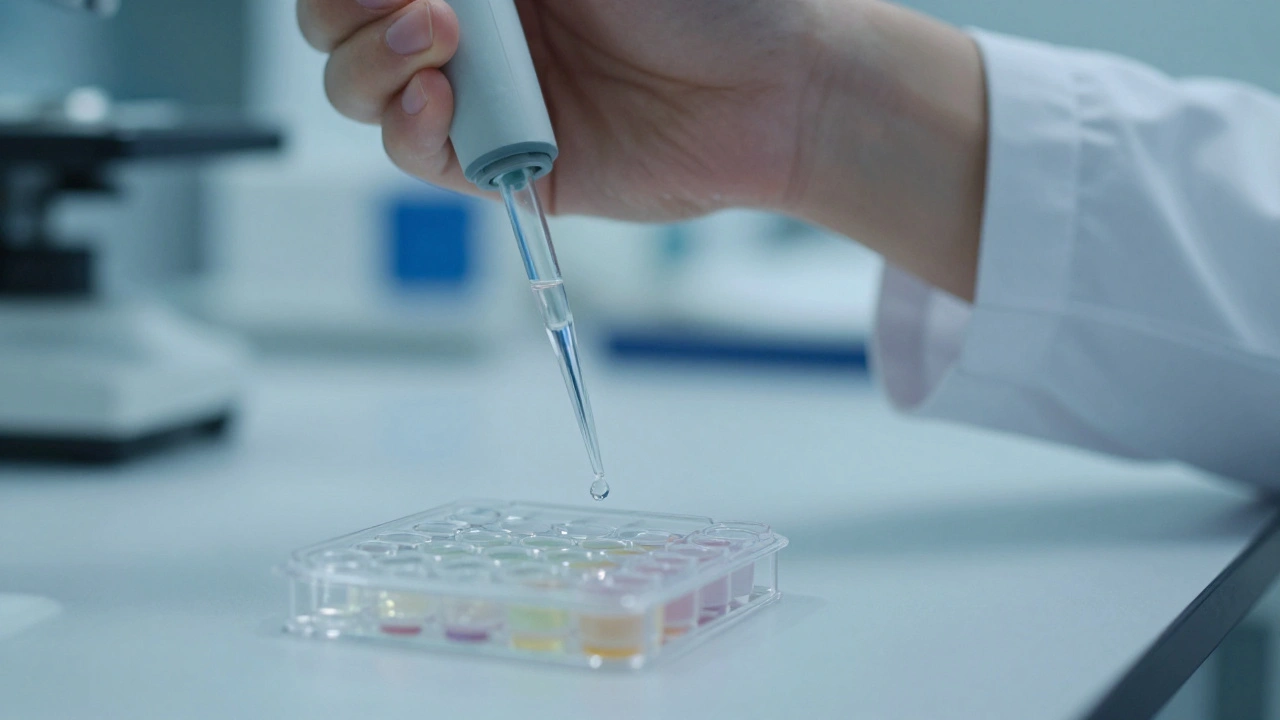
In forensic science, the difference between a breakthrough and a dead end often comes down to a few picograms of genetic material. When you're dealing with a touch DNA sample or a degraded biological stain, you can't afford to guess how much DNA you have. Using the wrong quantification tool doesn't just give you a bad number; it can lead to PCR failure or, worse, a misleading result. This is where DNA quantification kits is a specialized set of molecular biology reagents used to measure the exact concentration of deoxyribonucleic acid in a sample. By using fluorescent dyes that bind specifically to DNA, these kits tell you if you have enough material to proceed with profiling or if you're fighting an uphill battle against contaminants.
Understanding Sensitivity: Why It Matters for Low-Copy DNA
Not all quant kits are created equal. Depending on your sample-whether it's a high-yield bloodstain or a trace skin cell sample-you need to choose between Broad-Range and High-Sensitivity formulations. If you use a Broad-Range kit on a trace sample, the DNA concentration will likely fall below the detection limit, leaving you with a "no result" even though DNA is present.
For most forensic applications, high-sensitivity kits are the gold standard. For instance, the Quant-iT HS dsDNA Assay Kit from Thermo Fisher Scientific is designed for a linear range of 0.2 to 100 nanograms (ng). On the other end of the spectrum, the AccuBlue NextGen DNA assay from Biotium pushes sensitivity even further, detecting amounts as low as 1 to 3000 picograms (pg), which is crucial for Next-Generation Sequencing (NGS) library prep where every molecule counts.
If you are working with residual host cell DNA-common in biopharmaceutical forensics or contamination checks-digital PCR (dPCR) is the tool of choice. The QIAcuity platform allows for extreme precision, detecting as little as 5 femtograms (fg) of E. coli or CHO cell DNA. This level of sensitivity is light-years beyond traditional fluorometry and is essential when you need to prove a sample is virtually free of contamination.
| Kit Type/Product | Detection Range (Lower-Upper) | Best Use Case |
|---|---|---|
| Quant-iT HS dsDNA | 0.2 ng - 100 ng | General forensic trace samples |
| AccuBlue NextGen | 1 pg - 3000 pg | NGS & ultra-low input |
| QIAcuity (dPCR) | 5 fg - Variable | Residual DNA & contamination |
| Accuris High Sensitivity | 0.005 - 120 ng/μL | High-precision fluorometry |
The Battle with Inhibition: Detection and Tolerance
Sensitivity is great, but it's useless if your sample is "poisoned" by inhibitors. In forensics, inhibitors are everywhere: heme from blood, indigo dyes from denim, or humic acid from soil. These substances interfere with the Polymerase Chain Reaction (PCR) process, often leading to skewed quantification or total amplification failure.
Most modern quant kits are built to be "tolerant," meaning they can ignore a certain amount of junk in the tube. For example, the Quant-iT and Accuris ssDNA kits are documented to handle salts, detergents, and proteins without losing accuracy. However, there is a ceiling to this tolerance. When the inhibitor concentration is too high, the fluorescent dye may still bind to the DNA, but the downstream PCR will fail. This creates a dangerous gap where the quant kit says "you have DNA," but the profiler says "nothing here."
How do you detect this? While most kits don't have a built-in "inhibition alarm," the QIAcuity dPCR system provides a workaround. Because dPCR partitions the sample into thousands of tiny droplets, it effectively dilutes the inhibitors in each partition, making the reaction more robust than traditional qPCR. If you find that a sample requires DNA extraction to get a readable result on a QIAcuity system, it's a strong indicator that your protein or inhibitor levels were too high for a direct-read approach.
Selecting the Right Kit for Your Forensic Workflow
Choosing a kit isn't just about the lowest number on the box; it's about the type of DNA you're targeting. Most forensic work focuses on double-stranded DNA (dsDNA) , but there are times you need to look for single-stranded DNA (ssDNA) or RNA to assess sample degradation.
If you're quantifying oligonucleotides or degraded fragments, the Accuris ssDNA kit is a solid choice, though keep in mind it isn't as selective-it won't distinguish between ssDNA and RNA. If your goal is to check the viability of a sample via RNA, the AccuBlue Broad Range RNA kit offers one of the widest linear ranges available, ensuring you don't have to perform multiple dilutions just to get a reading.
For those prioritizing safety and lab environment, the AccuGreen and AccuBlue lines from Biotium are worth noting because they use non-toxic, non-mutagenic chemistry. This might seem like a minor detail, but in a high-throughput forensic lab, reducing the toxicity of your reagents is always a win for the staff.
Common Pitfalls in DNA Quantification
Even with a high-end kit, simple mistakes can ruin your data. One of the most common errors is the "dilution trap." Many users dilute their samples to fit within the linear range of a Broad-Range kit, but in doing so, they push the sample below the actual limit of detection. If you suspect a low-copy sample, always start with a High-Sensitivity kit rather than diluting a sample for a Broad-Range one.
Another issue is the stability of the signal. Most fluorescence-based assays, like the Quant-iT series, are stable for about three hours. If you load a plate and then get distracted by another case, your readings might drift. Always read your plates within the recommended window to ensure the data is reliable for court testimony.
Practical Checklist for Quantifying Challenging Samples
- Assess the Source: Is it a "clean" swab or a soil-heavy stain? If it's the latter, prioritize kits with high documented salt and solvent tolerance.
- Match the Range: Use High-Sensitivity (HS) for trace/touch DNA and Broad-Range (BR) for concentrated blood/saliva.
- Verify Purity: If the quant result is high but PCR fails, assume inhibition. Run a cleanup extraction or use a dPCR platform like QIAcuity to bypass the inhibitor.
- Check Selectivity: Ensure you aren't accidentally measuring RNA when you only want dsDNA. Use a highly selective kit like the Quant-iT HS to avoid overestimating your DNA yield.
- Calibrate: Always use the prediluted DNA standards provided in the kit to create a fresh standard curve for every run.
Can I use UV spectrophotometry instead of these kits?
Not if you need accuracy. UV absorbance (like NanoDrop) cannot tell the difference between double-stranded DNA, single-stranded DNA, RNA, and free nucleotides. In forensics, where purity is rarely 100%, this leads to significant overestimation of the DNA present. Fluorescence-based kits are far more selective.
What is the difference between pg, ng, and fg in these kits?
These are units of mass. 1 nanogram (ng) is 1,000 picograms (pg), and 1 picogram is 1,000 femtograms (fg). For perspective: a standard HS kit detects nanograms, an ultra-sensitive kit like AccuBlue NextGen detects picograms, and a dPCR system like QIAcuity can detect femtograms.
Do I always need to extract DNA before quantification?
Not necessarily. Many modern kits, including the QIAcuity residual DNA kits, can work directly on samples. However, if your sample is heavily contaminated with proteins or known PCR inhibitors, an extraction step is recommended to ensure the inhibitors don't interfere with the assay's accuracy.
How does digital PCR (dPCR) improve inhibition tolerance?
dPCR works by partitioning a single sample into thousands of individual droplets. This process effectively isolates the DNA template from the inhibitors in each droplet, preventing the inhibitors from dominating the entire reaction, which is a common problem in traditional bulk qPCR.
Which kit is best for NGS library preparation?
For NGS, you need extreme precision at very low concentrations. The AccuBlue NextGen DNA assay is specifically designed for this, with a detection range of 1-3000 pg, making it ideal for quantifying the small amounts of DNA used in library prep.
Next Steps for Lab Optimization
If you're seeing a pattern of "false positives" during quantification-where the kit says DNA is present but you can't get a profile-it's time to evaluate your extraction method. Switching to a more robust cleanup kit before quantification can remove the inhibitors that are fooling your fluorometer.
For labs moving toward a more digital workflow, testing a dPCR system for trace contamination checks is a logical next step. It provides a level of absolute quantification that traditional kits simply can't match, especially when the target is residual host cell DNA.