Imagine a forensic examiner staring at a partial, smudged print recovered from a cold case. For decades, the goal has been simple: find a match in a database to give a name back to a nameless person. But the reality of identifying unknown bodies is rarely that straightforward. While we often think of fingerprints as a perfect "digital signature," the process of fingerprint comparison is actually a complex mix of human intuition, chemical science, and now, cutting-edge artificial intelligence.
The Core of Identification: Minutiae vs. Patterns
When people talk about fingerprints, they usually mention loops, whorls, or arches. While these broad categories help organize data, they aren't what actually identify a person. You could have the same "loop" pattern as a thousand other people. The real secret lies in minutiae is the minute details of friction ridge skin patterns, such as ridge endings and bifurcations, that distinguish one person's fingerprints from another.
These tiny characteristics are what make a print unique, even among identical twins. When an examiner looks at an unknown body, they aren't just looking for a general shape; they are mapping the exact coordinates of where a ridge stops or splits. This level of detail is what allows forensic teams to move from a "possible match" to a legal identification.
How Examiners Match Unknown Prints
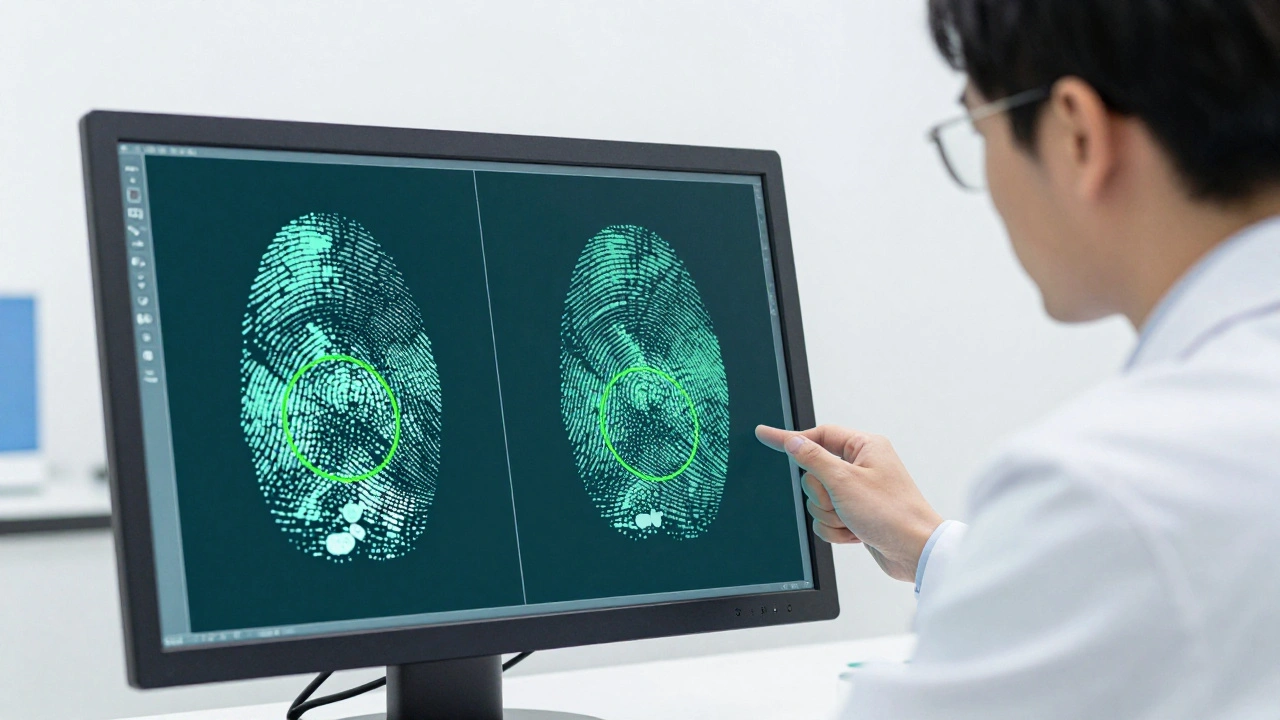
The process of identifying an unknown body usually starts with a side-by-side comparison. An examiner takes a "latent" print-one recovered from a scene or the body itself-and compares it against a known record. They look for specific points of similarity in the minutiae. If enough points align in the same relative positions, a match is declared.
To make this manageable, the industry has used systems like the Henry System is a classification system that organizes fingerprints into groups based on their patterns, allowing for a systematic search of large physical and digital databases. By narrowing the search to a specific group, investigators don't have to manually check every single record in a city's archive.
| Method | How it Works | Best Use Case | Impact on Evidence |
|---|---|---|---|
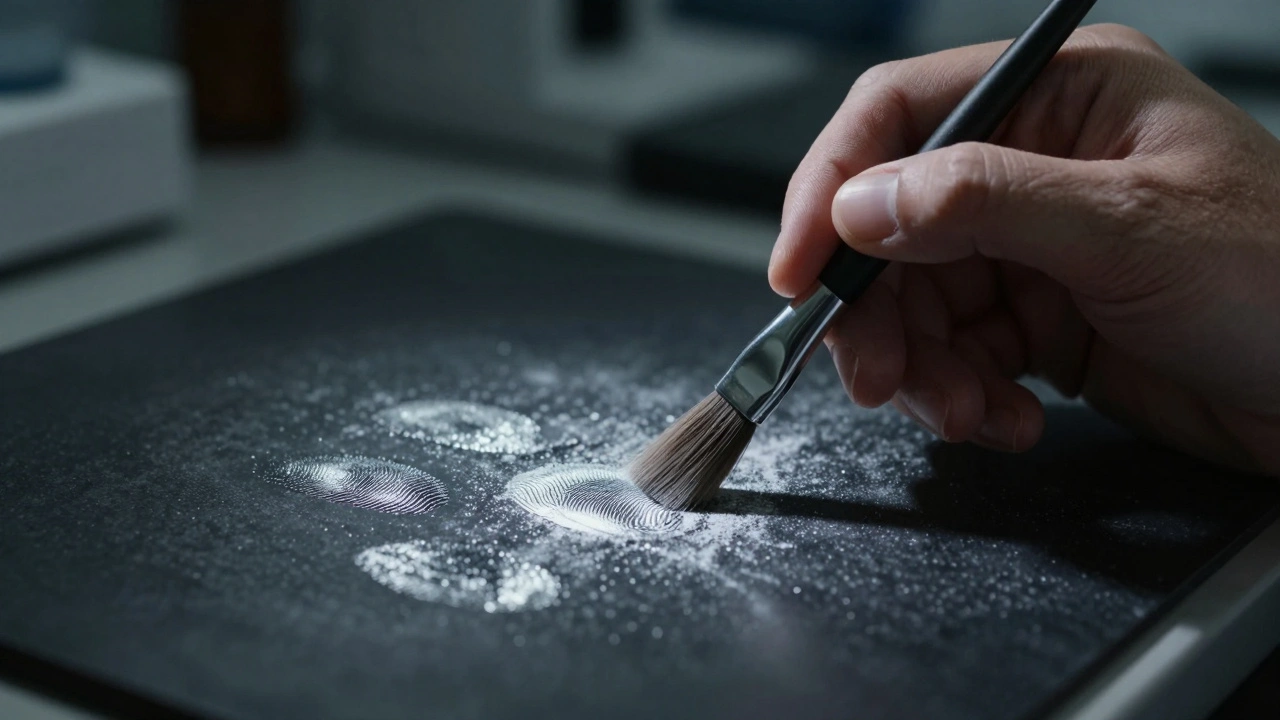
| Powder Application | Dust adheres to oils/residue | Non-porous surfaces (glass, plastic) | Low risk, but can smudge prints |
| Iodine Fuming | Chemical reaction causes discoloration | Porous surfaces (paper, cardboard) | Chemical alteration of the surface |
| Laser-Induced Fluorescence | Light excites molecules to glow | Complex or multicolored surfaces | Non-destructive, high resolution |
The AI Revolution: Challenging Old Assumptions
For a long time, the forensic community believed that fingerprints from different fingers of the same person were entirely unique and unmatchable. Essentially, the rule was: your index finger looks nothing like your ring finger. However, new research is flipping this script. A team at Columbia Engineering is an academic institution specializing in advanced technical research and applied sciences, recently challenging traditional forensic beliefs through AI has discovered that intra-person fingerprints actually share hidden similarities.
By using a deep contrastive network-a type of AI designed to find subtle patterns-researchers trained a system on about 60,000 fingerprints from a U.S. government database. The AI could identify when two different fingers belonged to the same person with 77% accuracy in single pairs. When multiple prints were analyzed, the accuracy jumped even higher.
Why does this matter for unknown bodies? If an investigator only has a partial print from a thumb but the database only has a clear record of a pointer finger, traditional methods might fail. An AI-assisted system could recognize the "familial" similarity between those fingers, potentially increasing identification efficiency by more than ten times.
Dealing with "Difficult" Remains
Not every body comes with a clean set of prints. Decomposition, water damage, or burns can destroy the friction ridge skin. In these cases, forensics teams have to get creative. This is where advanced recovery techniques come in.
When standard powders fail, laser-induced fluorescence is a modern detection technology that uses specific wavelengths of light to make fingerprint residues glow without damaging the underlying sample is a game-changer. It allows examiners to see prints on surfaces that would normally hide them, and because it's non-destructive, the evidence remains intact for future testing.
If the skin is too damaged for any visual print, forensic scientists move to complementary methods. While DNA is the gold standard for degraded remains, it's expensive and slow. Fingerprint comparison remains the first line of defense because it's faster and, when successful, provides an immediate lead.
The Future of Forensic Identification
The shift toward AI doesn't mean human examiners are obsolete. Instead, the role is evolving. The human expert provides the context and the final verification, while the AI handles the massive data-crunching required to find patterns the human eye simply cannot see.
We are moving toward a hybrid model where forensic identification is a layered process. It starts with rapid AI screening, follows with meticulous human minutiae verification, and ends with DNA confirmation if the case is particularly complex. This multi-layered approach ensures that fewer people remain "unknown" and more families get the closure they need.
Can identical twins have the same fingerprints?
No. While identical twins share the same DNA, fingerprints are formed by both genetics and the environment in the womb (such as the way the fetus touches the amniotic sac). This results in unique minutiae patterns for every single person, including twins.
What is the difference between a latent print and a known print?
A latent print is an invisible or barely visible mark left by oils and sweat on a surface. A known print is a clear, ink-on-paper or digital record taken directly from a person's finger for identification purposes.
How does AI improve the speed of identifying unknown bodies?
AI can scan millions of records in seconds, looking for similarities in minutiae that a human might miss. More importantly, new AI models can detect similarities between different fingers of the same person, expanding the number of potential matches in a database.
What happens if fingerprints are too degraded to use?
If fingerprints are unavailable, forensic teams turn to other identification methods. This includes dental record comparison, skeletal analysis (forensic anthropology), and DNA profiling to identify the individual.
Is the Henry System still used today?
While most modern agencies use AFIS (Automated Fingerprint Identification Systems), the principles of the Henry System provided the foundation for how prints are categorized and stored, and it is still taught to understand the logic of classification.