You’ve got the skills. You’ve got the passion for solving crimes through science. But you’re staring at a budget sheet that looks more like a crime scene than a funding plan. Here’s the hard truth: grant funding is the oxygen that keeps forensic research careers alive. Without it, you’re stuck doing routine casework instead of pushing the field forward. And let’s be honest-nobody entered this field to just process samples forever.
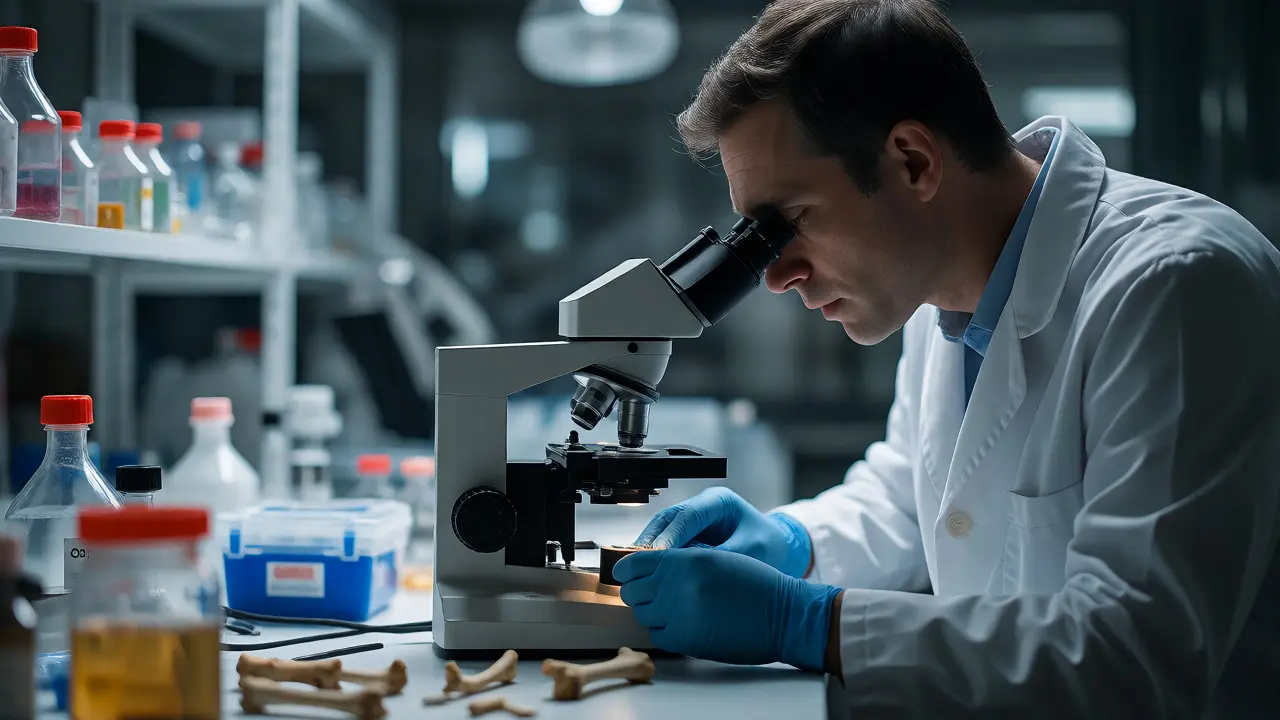
If you’re a forensic scientist, a grad student, or an early-career researcher, you need money to innovate. Maybe you want to improve DNA extraction methods from degraded bones. Maybe you’re trying to validate a new toxicology assay. Whatever your niche, securing funding isn’t luck-it’s a skill. This guide cuts through the bureaucracy and shows you exactly where the money is hiding and how to grab it before someone else does.
The Big Three: Who Actually Pays for Forensic Science?
Stop sending generic emails to random departments. In the United States, three entities control about 80% of federal forensic research dollars. Knowing who they are saves you months of wasted effort.
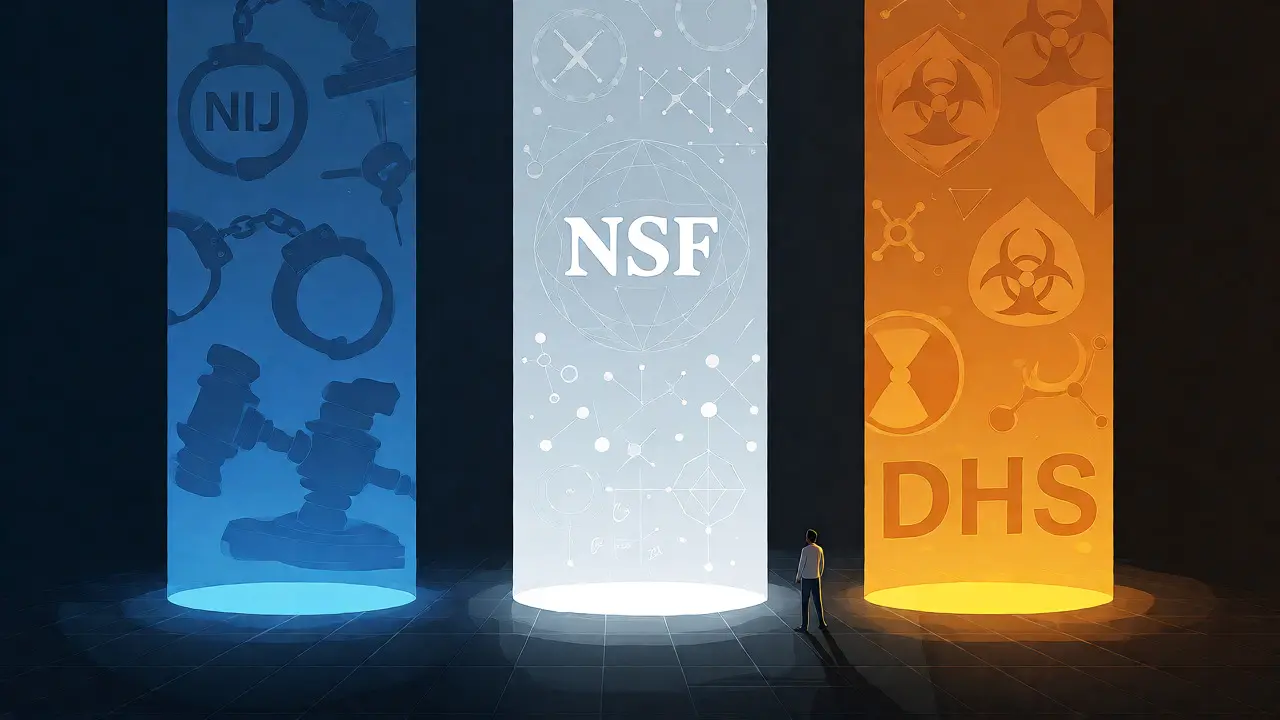
National Institute of Justice (NIJ) is the primary source for applied forensic research. It falls under the Office of Justice Programs within the U.S. Department of Justice. Unlike pure academic grants, NIJ wants solutions to real-world criminal justice problems. They don’t care if your study has a perfect theoretical framework if it doesn’t help a detective close a case faster. Their typical awards range from $50,000 for pilot studies to over $1 million for large-scale validations. The key here is practicality. If your proposal reads like a philosophy thesis, toss it. NIJ funds things that work in a lab tomorrow.
National Science Foundation (NSF) takes a different angle. While NIJ focuses on application, NSF focuses on fundamental science. If you’re studying the chemistry of decomposition in unique soil types or developing new algorithms for fingerprint matching, NSF might be your best bet. They fund high-risk, high-reward ideas. However, their success rates are notoriously low-often below 20%. To win here, you need to prove your work advances general scientific knowledge, not just police procedures. Many successful forensic researchers start with NIJ for immediate impact and move to NSF for deeper theoretical exploration later in their careers.
Department of Homeland Security (DHS) has become a sleeper hit for specific niches. Since 9/11, DHS has poured billions into bioterrorism and chemical threat detection. If your research involves detecting explosives residues, identifying biological agents, or rapid screening technologies, look at DHS’s Domestic Nuclear Detection Office (DNDO) or the Science and Technology Directorate. These grants often come with massive budgets because national security is non-negotiable. But beware: the compliance paperwork is heavier than a lead-lined vest.
| Agency | Primary Focus | Typical Award Size | Best For |
|---|---|---|---|
| National Institute of Justice (NIJ) | Applied Criminal Justice Solutions | $50k - $1M+ | Validation studies, method improvements, tool development |
| National Science Foundation (NSF) | Fundamental Scientific Discovery | $100k - $500k | New theories, algorithmic breakthroughs, basic biology/chemistry |
| Dept. of Homeland Security (DHS) | Threat Detection & Security | $200k - $2M+ | Bioterrorism, explosive detection, rapid screening tech |
State-Level Grants: The Hidden Goldmine
Everyone fights for the federal pie, but few people look at their own backyard. State-level grants are less competitive because fewer applicants know they exist. If you live in California, New York, or Texas, check your state’s Attorney General office or Department of Public Safety. Many states have dedicated forensic science commissions that distribute leftover budget funds annually.
Take Oregon, for example. The Oregon Criminal Justice Commission occasionally releases small grants for local labs to upgrade equipment or hire research assistants. These aren’t life-changing millions, but a $15,000 grant can buy a new centrifuge or fund a summer internship. More importantly, winning a state grant builds your track record. Federal reviewers love seeing that you’ve successfully managed smaller pots of money first. It proves you won’t burn through a $500,000 award on bad coffee and travel expenses.
Don’t ignore university-internal grants either. Most major universities have internal research funds specifically designed to help faculty write their first big federal proposal. These "seed grants" usually range from $5,000 to $25,000. Use them to generate preliminary data. Why? Because federal agencies rarely fund projects based solely on an idea. They fund projects backed by proof-of-concept data. That $10,000 seed grant lets you run the pilot experiment that makes your NIJ proposal undeniable.
Anatomy of a Winning Proposal
So you found a grant opportunity. Now what? Most rejections happen before the reviewer even finishes the first page. Your proposal needs to speak the language of the funder. Here is the formula that works:
- The Problem Statement: Start with pain. Don’t say "DNA analysis is important." Say "Current DNA extraction methods fail on 40% of bone fragments recovered from mass disasters, leaving families unidentified." Specificity sells.
- The Gap: Explain why current solutions suck. Cite recent papers (last 3-5 years) showing where existing methods fall short. If you can’t find gaps, your project isn’t novel enough.
- The Solution: Describe your method clearly. Avoid jargon soup. Imagine explaining it to a smart lawyer who hates science. Keep it simple.
- The Impact: Connect dots explicitly. How does this save time? Reduce costs? Increase accuracy? Quantify it. "This method reduces processing time by 2 hours per sample" beats "This method is faster."
One common mistake? Over-promising. Reviewers are skeptical humans. If you claim your new software will solve all cold cases, they’ll roll their eyes. Instead, promise a validated prototype that improves efficiency by 15%. Under-promise, over-deliver. It builds trust.

Pitfalls That Kill Applications
I’ve reviewed dozens of rejected proposals. The reasons for rejection are surprisingly consistent. Here are the top killers:
- Ignoring the Solicitation Guidelines: If the call says "limit to 10 pages," do not send 11. If it asks for a specific font size, use it. Bureaucrats reject technically strong proposals for formatting errors because it signals carelessness. If you can’t follow instructions, how can you follow chain-of-custody protocols?
- Lack of Collaboration: Forensic science is interdisciplinary. If you’re a chemist proposing a DNA study, team up with a biologist. If you’re building software, partner with a statistician. Solo projects often lack credibility unless you’re already a world-renowned expert in that exact sub-field.
- Vague Budgets: Don’t just list "Personnel: $50,000." Break it down. "Graduate Assistant (50% FTE): $25,000; Lab Technician (25% FTE): $15,000." Reviewers want to see you’ve thought about resource allocation. Also, remember to include indirect costs (overhead). If your university charges 50% overhead, a $100,000 direct cost request becomes a $150,000 total ask. Hiding this leads to awkward conversations later.
Building a Career Around Grants
Securing one grant is nice. Building a career around continuous funding is better. Successful forensic researchers treat grant writing as a recurring job duty, not a side hustle. Set a calendar reminder every six months to scan for new opportunities. Join listservs like the American Academy of Forensic Sciences (AAFS) funding announcements. Attend webinars hosted by the NIJ-they often reveal upcoming priorities before the formal calls drop.
Also, consider private foundations. The MacArthur Foundation or the Sloan Foundation sometimes fund innovative scientific approaches outside traditional government channels. These grants often have less red tape and more flexibility. You can spend the money on weird things-like buying a specialized microscope or attending a conference in Japan-that federal grants might restrict.
Finally, network relentlessly. Go to conferences. Talk to program officers. Ask them, "What are you looking for next year?" They’ll tell you. Then tailor your next proposal to those answers. It’s not cheating; it’s strategic alignment. Remember, funding agencies want to give money away to good projects. Help them feel safe giving it to you.
How long does it take to get a forensic research grant?
The timeline varies significantly by agency. For the National Institute of Justice (NIJ), expect 6 to 9 months from submission to award notification. The National Science Foundation (NSF) typically takes 6 to 8 months. Private foundations may move faster, sometimes within 3 months, but their cycles are irregular. Always plan your cash flow assuming you won't receive funds for at least half a year after applying.
Can I apply for federal grants if I'm not affiliated with a university?
Generally, no. Most federal grants require a fiscal agent, such as a university, non-profit organization, or government agency, to manage the funds. Individuals cannot directly receive most NIH or NSF grants. However, some smaller private fellowships allow individual applications. If you're independent, consider partnering with a local university or non-profit that can act as your fiscal sponsor.
What is the average success rate for forensic science grants?
Success rates fluctuate yearly based on budget appropriations. Historically, NIJ success rates hover between 10% and 15% for general solicitations. NSF rates are often lower, around 15-20%, depending on the directorate. Specialized programs or small grants may have higher acceptance rates, sometimes reaching 25-30%. Persistence is key; many funded researchers were rejected multiple times before succeeding.
Do I need to pay back unused grant money?
Yes, typically. Unspent funds must be returned to the federal treasury at the end of the grant period unless you request a no-cost extension. Unused money doesn't disappear; it goes back to the pool. Plan your budget conservatively to avoid returning significant amounts, which can look like poor planning in future reviews.
Are there grants specifically for minority-owned forensic businesses?
Yes. The Small Business Administration (SBA) offers SBIR/STTR grants that prioritize small businesses, including those owned by minorities, women, and veterans. Additionally, the NIJ has initiatives aimed at increasing diversity in forensic research. Check for specific solicitations labeled as "Small Business Innovation Research" or similar designations when browsing federal opportunities.