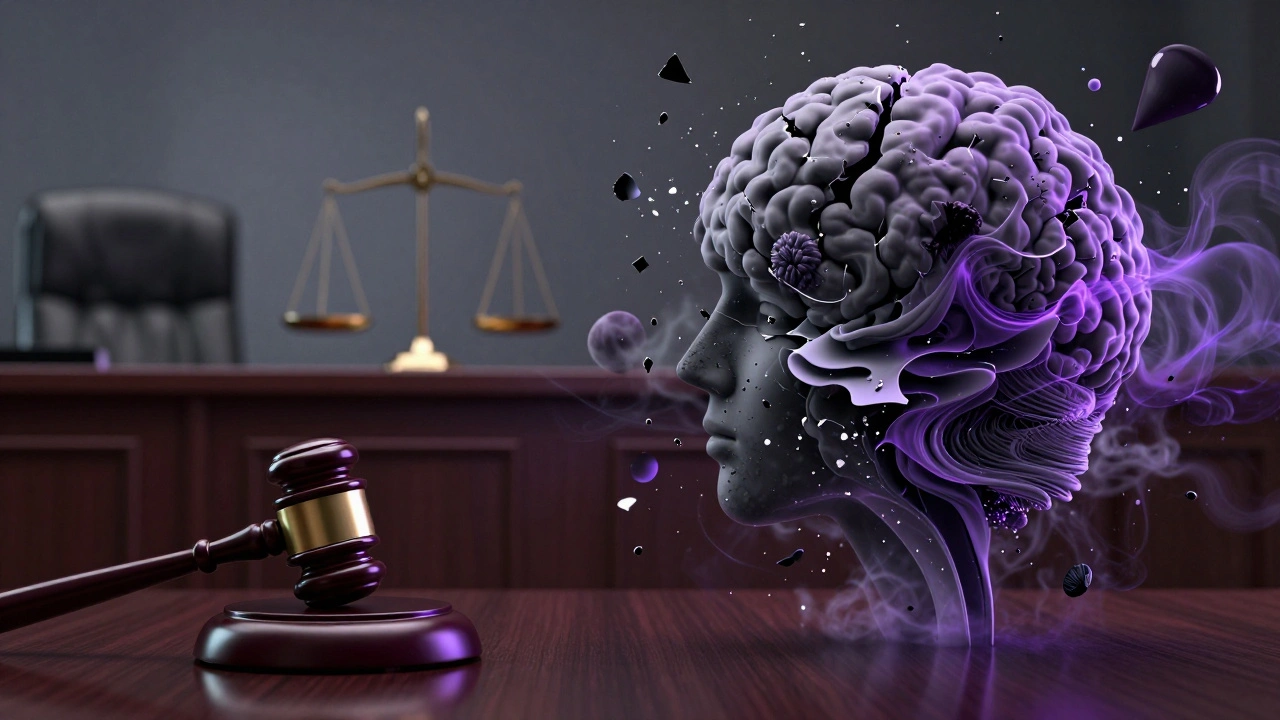
Imagine someone committing a violent crime, but in their mind, they were fighting off a demon or following a direct command from a deity. To most of us, the act is horrific. But to the law, the question isn't just "did they do it?" but "were they actually responsible for it?" This is where the insanity defense is a legal mechanism that recognizes the unfairness of punishing people who have a substantial impairment of mental function at the time of their crime. It's one of the most misunderstood parts of the courtroom, often portrayed in movies as a "get out of jail free" card, but in reality, it's a complex intersection of psychiatry and law.
The Big Difference Between Mental Illness and Legal Insanity
First, we even need to clear up a huge misconception: being mentally ill is not the same as being legally insane. You can have a diagnosed psychiatric disorder-like severe depression or schizophrenia-and still be held fully responsible for your actions in court. Legal Insanity is a legal term, not a medical diagnosis. While a doctor looks at symptoms to treat a patient, a judge looks at mental capacity to determine culpability.
For a crime to be punishable, the law generally looks for two things: the actus reus (the physical act of the crime) and the mens rea (the "guilty mind" or intent). If a person's mental state was so shattered that they couldn't form that intent or understand that what they were doing was wrong, the law argues that punishing them doesn't serve the purpose of justice. It's not about whether the person is "sick," but whether they were capable of choosing to follow the law.
The Three Main Legal Tests for Insanity
Depending on where a crime happens, the court uses different rules to decide if someone is insane. Some are strict, while others are more flexible.
The M'Naghten Rule: The Cognitive Test
The M'Naghten Rule is the oldest and toughest standard. It focuses purely on cognition. To win with this defense, the defendant must prove that at the time of the crime, they didn't understand the nature of their act, or if they did, they didn't know it was wrong. It's a very narrow window. If you knew the act was illegal but felt you had to do it, you'd likely fail this test because you still "knew" it was wrong.
The Model Penal Code (ALI-MPC): The Balanced Approach
The Model Penal Code (or ALI-MPC) is used in many U.S. states and is much broader. It uses a two-pronged approach. First, it looks at whether the person could appreciate the wrongfulness of their conduct (the cognitive part). Second, it looks at whether they could control their behavior (the volitional part). This means someone could be found not guilty if they knew the act was wrong but had a mental defect that made it impossible for them to stop themselves.
The Federal Standard: The Strict Version
If you're in federal court, the rules change. The federal standard (18 U.S.C. § 17(a)) is similar to M'Naghten because it gets rid of the "volitional" prong entirely. You can't argue that you "couldn't help it." Additionally, the federal law requires the mental disease to be "severe." This is designed to keep people with personality disorders or antisocial tendencies-who might be "difficult" but aren't psychotic-from using the insanity defense.
| Standard | Focus | Cognitive Prong? | Volitional Prong? | Strictness |
|---|---|---|---|---|
| M'Naghten | Knowledge of wrong | Yes | No | High |
| Model Penal Code | Knowledge & Control | Yes | Yes | Moderate |
| Federal Standard | Severe impairment | Yes | No | High |

Who Has to Prove What? The Burden of Proof
In most criminal cases, the prosecution has to prove everything. But the insanity defense often flips the script. In the majority of states and under the Model Penal Code, the burden of proof is on the defendant. This means the defense has to bring in experts and evidence to show the person was insane.
However, there are outliers. In Massachusetts, for example, the burden is on the state to prove the defendant was sane. This is a huge legal difference. Most of the time, the process is a two-step dance: the defense provides evidence of a mental defect, and then the prosecution tries to prove the person was actually sane by a "preponderance of the evidence," which basically means it's more likely than not that they were sane.
The Timing: Why the Moment of the Crime is Everything
One of the biggest pitfalls in these cases is focusing on the wrong time. A judge doesn't care if the defendant is currently in a state of psychosis while sitting in the courtroom. The only moment that matters is the exact time the offense was committed. This is a temporal requirement.
To figure this out, experts look at a cluster of facts:
- The defendant's psychiatric history leading up to the event.
- Their motive-was it a rational motive or a delusional one?
- Their behavior immediately after the crime (did they try to hide it, or did they stand there confused?).
- Clinical evaluations and psychological tests.
Simply being "odd" or "irascible" isn't enough. Courts have consistently ruled that having a weak intellect or an unusual personality doesn't equal legal insanity. There has to be a specific mental disease or defect causing the lack of control or understanding.
How Experts Determine Insanity
Psychologists and psychiatrists don't just guess; they use a mix of structured and unstructured tools. While there isn't one single "insanity test" that gives a yes/no answer, they use comprehensive evaluations. This includes reviewing medical records, conducting clinical interviews, and using standardized psychological assessments to see if the defendant's behavior aligns with a known severe mental disorder.
Interestingly, you don't always need a psychiatrist to win an insanity case. Non-psychiatric testimony-like a witness who saw the defendant talking to invisible people right before the crime-can be just as valuable in court as a doctor's report. The goal is to build a picture of the defendant's mind at that specific micro-moment in time.
Does the insanity defense mean the person goes home?
Almost never. A successful insanity plea usually results in "Not Guilty by Reason of Insanity" (NGRI). Instead of prison, the person is typically committed to a secure psychiatric hospital. They often stay there longer than they would have spent in prison, only being released once a court determines they are no longer a danger to themselves or others.
Can someone use the insanity defense for a crime they planned?
It's much harder, but possible. Planning suggests a level of cognitive function (mens rea). However, if the planning was driven by a delusion-such as believing they were saving the world from an alien invasion-the defense may still work. The court looks at whether the "plan" was rational or the product of a diseased mind.
What is the "Irresistible Impulse" test?
This is a volitional test used in some jurisdictions, like Virginia. It allows a defendant to be found not guilty if they knew the act was wrong but were completely unable to stop themselves due to a mental disorder. It focuses on the loss of self-control rather than the loss of understanding.
Can a person plead insanity after they've already been convicted?
Generally, no. The insanity defense is raised during the trial phase. Once a verdict is reached and the appeals process is exhausted, it's very difficult to introduce a new insanity claim unless significant new evidence of a mental defect comes to light.
Does intoxication count as insanity?
No. Voluntary intoxication (drinking or using drugs by choice) is almost never accepted as a basis for an insanity defense. Legal insanity requires a "disease or defect" of the mind, not a temporary state caused by substance abuse.
What Happens Next?
If you're interested in how the mind interacts with the law, you might want to look into diminished capacity. This is a "lesser" version of the insanity defense. Instead of getting a "not guilty" verdict, diminished capacity can sometimes reduce a charge (like from first-degree murder to manslaughter) because the person couldn't form the specific intent required for the higher crime.
For those working in criminal profiling or law enforcement, understanding these standards is key. Recognizing the difference between a calculated criminal and someone in a state of total psychological collapse changes everything from how you interview a suspect to how you analyze a crime scene.