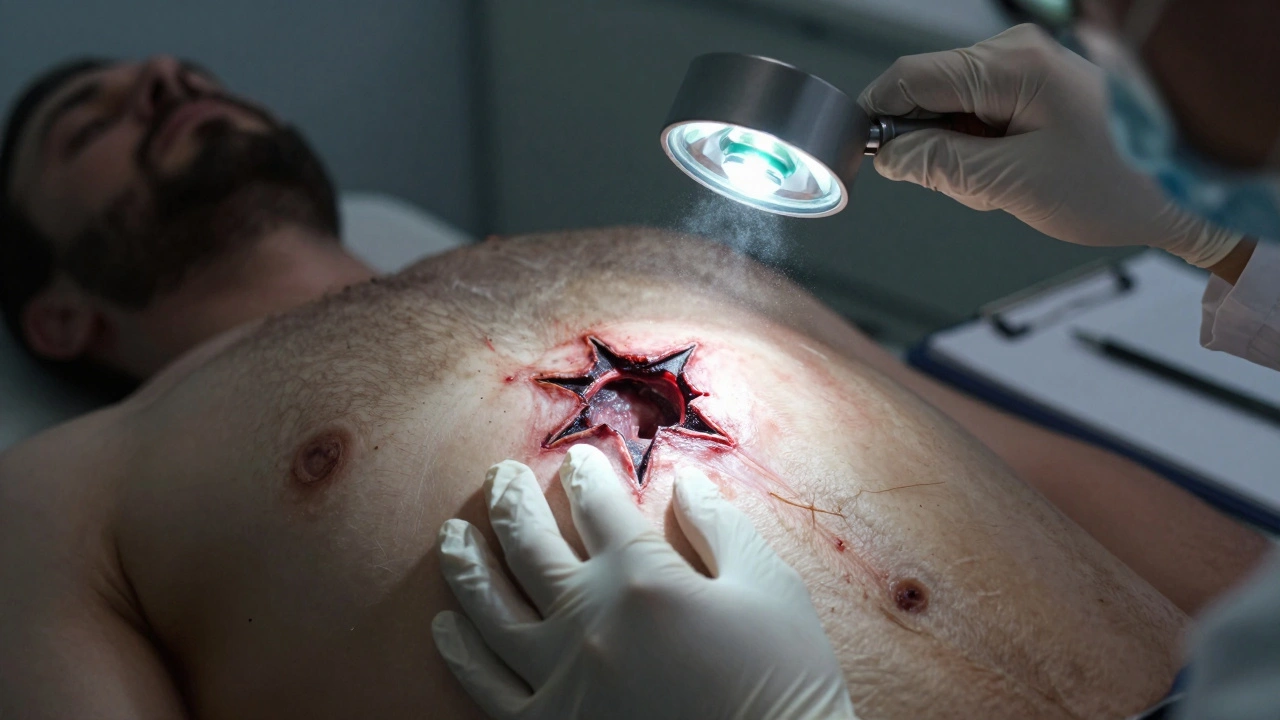
When a firearm is discharged, the wound it leaves behind isn’t just a hole in the skin. It’s a detailed record of what happened in the split second before impact. Forensic pathologists can tell you the distance the gun was fired from - sometimes within inches - just by looking at the wound. This isn’t guesswork. It’s science built on decades of observation, testing, and real-world cases. Whether it’s a contact wound with seared skin and a muzzle imprint, or a distant wound with nothing but an abrasion collar, each pattern tells a story. And in criminal investigations, that story can make or break a case.
Contact Wounds: The Muzzle Was Right Against the Skin
When the barrel of a gun touches the skin before firing, you get a contact wound. This is the closest possible range, and it leaves unmistakable signs. The hot gases, flame, and unburned gunpowder don’t just exit the barrel - they get pushed directly into the skin. The result? A wound that looks torn, not punched.
Look for a stellate tear - a star-shaped rupture around the entrance. This happens because the pressure from the gases ruptures the skin outward. In head wounds, where bone lies under the skin, this tear is especially pronounced. You’ll also see seared skin, where the heat from the muzzle burns the tissue. Sometimes, the skin is literally pressed into the barrel’s shape, leaving a muzzle imprint. It’s like a fingerprint from the gun itself.
Inside the wound tract, you’ll find soot and gunpowder residue deep embedded. These aren’t surface stains - they’re driven in by the force of the discharge. In loose contact wounds, where there’s a tiny gap (a few millimeters), some gases escape, leaving a ring of soot around the wound. But even then, the imprint and searing remain. If you see these signs together - searing, imprint, soot, and tearing - you’re looking at a contact wound. No other range produces this exact combination.
Close-Range Wounds: Soot, Stippling, and Singed Hair
When the gun is fired from 1 to 20 centimeters away, you’re in the close-range zone. The muzzle is too far to leave an imprint, but close enough for flame, smoke, and powder to hit the skin. The key indicators here are soot deposits, stippling (also called tattooing), and hair singeing.
Soot looks like a dark, smudgy ring around the entrance. It’s made of carbon from partially burned gunpowder. Unlike in contact wounds, this soot sits on the skin surface - it can be wiped away. Stippling is the real giveaway. It shows up as dozens of tiny, pinpoint abrasions scattered around the wound. These are caused by unburned or partially burned powder grains striking the skin at high speed. Each one is like a miniature burn.
The pattern of stippling changes with distance. At 5 centimeters, you’ll see a dense cluster. At 15 centimeters, it thins out. If the victim had hair, you might notice singed strands around the wound - a clear sign that flame reached the skin. For shotgun wounds, the pattern looks different. Instead of a single hole, you’ll see a central wound surrounded by a scalloped edge, caused by the pellets spreading just enough to form a ring.
Here’s the catch: this evidence is fragile. Emergency responders often wash wounds before forensic teams arrive. Soot can disappear with soap and water. That’s why documenting the scene immediately is critical. If the body is moved before photos are taken, you lose vital clues.
Intermediate-Range Wounds: The Middle Ground
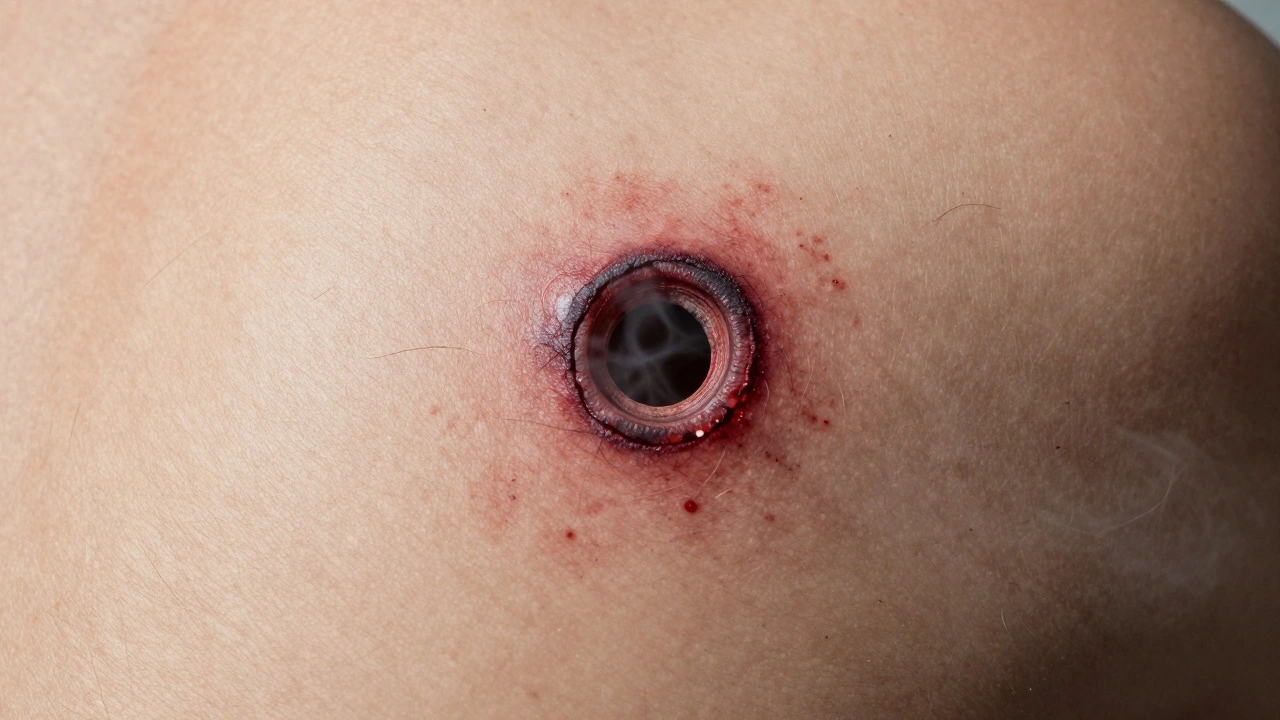
Between 20 and 90 centimeters, the gun is far enough that flame doesn’t touch the skin - but gunpowder still does. This is the intermediate range. The only clear indicator here is stippling without soot. No searing. No hair singeing. No black smudge around the hole. Just those tiny abrasions scattered in a pattern that gets wider as distance increases.
Why does this happen? The gunpowder particles lose energy as they travel. At close range, they’re still hot and fast enough to burn. At intermediate range, they’re cool but still hard enough to pierce the skin. The pattern they leave is like a fingerprint of distance. A dense cluster? Probably 30 centimeters. A scattered ring? Maybe 70.
For shotguns, intermediate range means the pellets have spread into a recognizable pattern. You’ll see a central wound with satellite holes around it - like a cluster of small punctures forming a halo. Sometimes, the wad (the plastic or paper cup that holds the pellets) hits the skin too, leaving a distinct mark. But this only happens if the wad doesn’t disintegrate before impact.
Here’s where things get tricky: clothing changes everything. A bullet fired through a thick coat might strip away all the powder residue before hitting the skin. What looks like a distant wound might actually be an intermediate shot through fabric. That’s why examiners don’t rely on wound patterns alone. They check the victim’s clothes, the scene, and the weapon’s ballistics.
Distant Wounds: Only the Bullet Makes Contact
Once you’re past 90 centimeters - or even as close as 60 if the gun has low powder charge - you enter the distant range. At this point, only the bullet itself reaches the skin. No smoke. No powder. No flame. Just a clean hole.
The only consistent feature? The abrasion collar. This is a ring of scraped skin around the entrance, caused by friction as the bullet punches through. It looks like a small, circular bruise. The size and shape depend on the angle. If the bullet hit at a sharp angle, the collar will be stretched out. If it hit straight on, it’ll be tight and even.
For single-projectile firearms, this is the end of the line. No other signs. No soot. No stippling. No burns. That’s why these wounds are sometimes called “indeterminate” - not because we don’t know what happened, but because we can’t prove the distance. The absence of indicators doesn’t automatically mean long range. It just means nothing extra reached the skin.
Shotguns at distant range look completely different. Beyond 10 meters, the pellets are fully spread. Instead of a central wound, you’ll see dozens of tiny holes scattered over an area the size of a hand. No scalloped edge. No wad marks. Just isolated punctures. It looks less like a gunshot and more like a spray of nails.
The One Constant: The Abrasion Collar
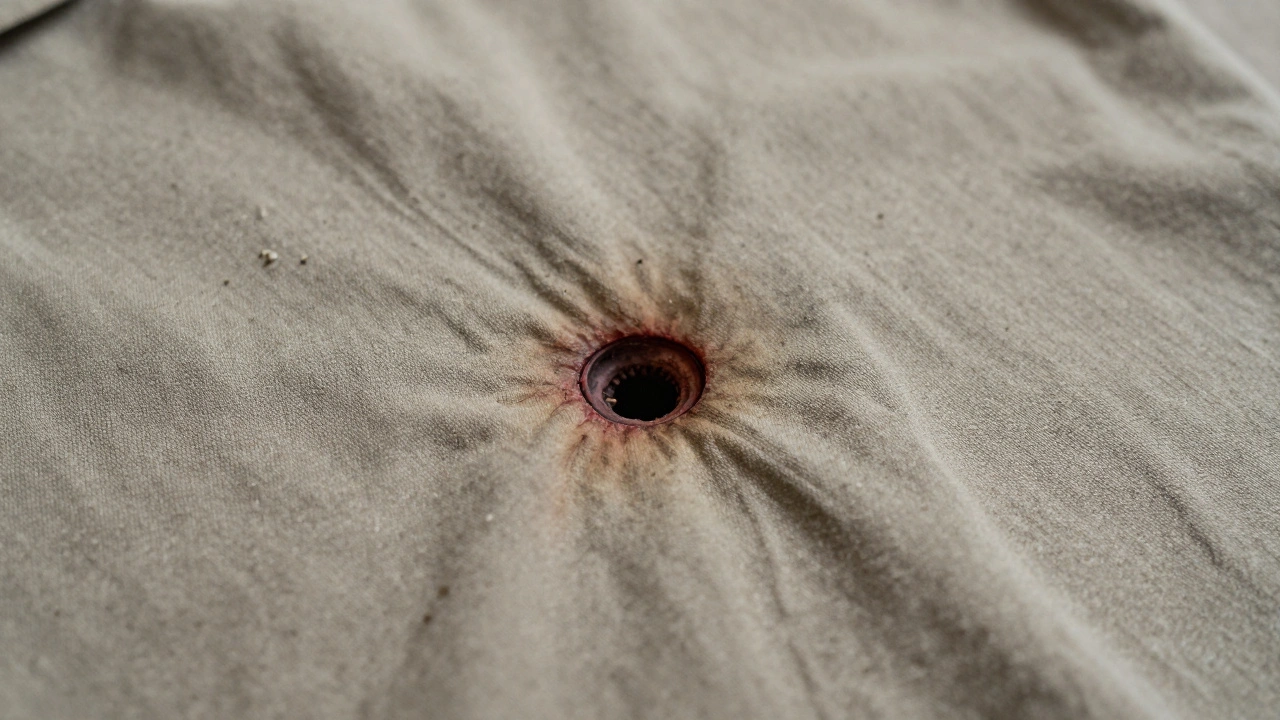
No matter the distance - contact, intermediate, or distant - every entrance wound has one thing in common: the abrasion collar. It’s the only feature that never disappears. Even in contact wounds, where there’s soot, searing, and tearing, the collar is still there, hidden under the damage. It’s what helps forensic examiners confirm that the wound is an entrance, not an exit.
Exit wounds don’t have abrasion collars. They’re usually larger, ragged, and often have tissue protruding. The collar is the key to telling them apart. And it’s also the only clue left when everything else has been washed away, covered by clothing, or altered by the bullet’s path.
Why This Matters: More Than Just Wound Patterns
Forensic experts don’t just look at wounds in isolation. They piece together the whole scene. Did the shooter stand 20 centimeters away? Or did they fire through a curtain? Was the gun cleaned after the shooting? Are there powder residues on the victim’s clothing that weren’t on the skin?
One case from 2022 in Portland involved a man found with a single gunshot wound to the chest. No soot. No stippling. Just an abrasion collar. At first glance, it looked like a distant shot. But when the victim’s shirt was examined, there was a small, smudged pattern of powder on the fabric - exactly where the bullet passed through. That meant the gun was fired at intermediate range. The shirt had filtered out the residue. Without that detail, the case could have gone the wrong way.
That’s why distance classification isn’t a checklist. It’s a framework. It tells you what to look for - but not what to assume. Every weapon behaves differently. A .38 revolver might leave powder residue up to 70 centimeters. A 12-gauge shotgun might not leave any beyond 50. That’s why examiners test the exact weapon used, fire it at known distances, and compare the results.
Forensic ballistics isn’t magic. It’s methodical. It’s repeatable. And when done right, it turns a simple wound into a timeline of events - down to the last millimeter.
Can a distant gunshot wound be mistaken for a contact wound?
No. A contact wound always shows signs of close-range discharge - searing, soot, muzzle imprint, or tearing. A distant wound has none of these. The only shared feature is the abrasion collar, which appears in both. But without the other indicators, you can’t confuse the two. If a wound looks like a distant wound but has soot, it’s likely an intermediate or close-range shot that was misinterpreted.
Does clothing affect gunshot wound indicators?
Yes, dramatically. Clothing can block soot, wipe away stippling, or even alter the shape of the wound. A bullet fired through a thick coat may leave no powder residue on the skin, making a close-range shot look distant. Forensic examiners always examine clothing layers for powder patterns, burn marks, and bullet holes to reconstruct what happened. The skin wound alone isn’t enough.
Why do shotgun wounds look different at various distances?
Unlike single-bullet firearms, shotguns fire multiple pellets. At contact range, the pellets stay tightly grouped, creating a single large wound. As distance increases, they spread out. At intermediate range, you see a central wound with smaller holes around it. Beyond 10 meters, the pellets scatter so much they look like dozens of separate punctures - no central wound, no wad marks. This makes shotgun wounds easier to classify by range than those from handguns or rifles.
Can a wound be both intermediate and distant at the same time?
No. A wound is classified based on the presence or absence of specific indicators. If you see stippling without soot, it’s intermediate. If you see only an abrasion collar, it’s distant. But if intermediate objects like clothing or glass are involved, they can mask indicators. That doesn’t change the classification - it just means the distance can’t be determined from the wound alone. You need other evidence.
Is the abrasion collar always visible?
Almost always. It’s created by the bullet scraping the skin as it enters. Even in contact wounds with heavy soot or tearing, the collar is present beneath the damage. It’s the one consistent feature across all ranges. If it’s missing, the wound might not be an entrance - or the skin was severely damaged by another factor, like fire or explosion.