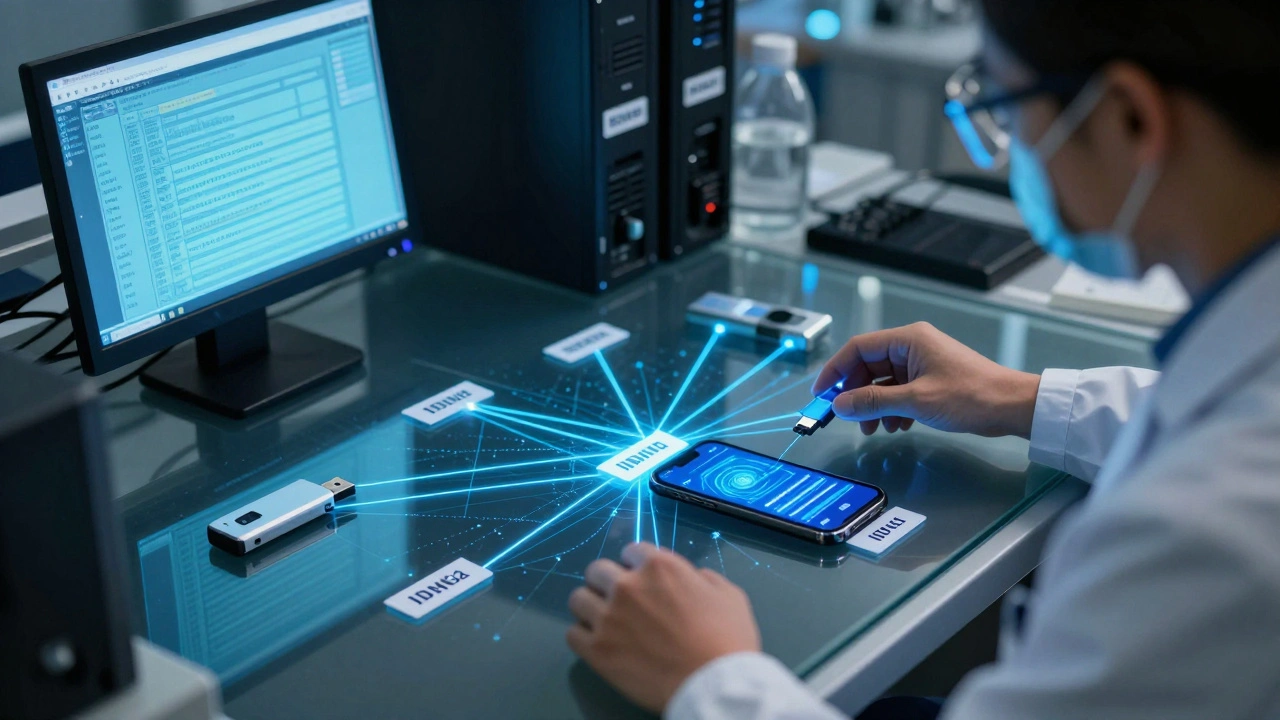
When investigators handle evidence from multiple crime scenes, the old way of just logging who touched what and when isn’t enough anymore. You can have a perfect chain of custody - every transfer documented, every signature checked - but if you can’t prove that the USB drive from Scene A is connected to the server logs from Scene B, then you’re missing the real story. This is where traceability changes everything. It’s not about who handled the evidence. It’s about how the evidence connects.
Why Traditional Chain of Custody Falls Short
Traditional chain of custody is a paper trail. It tells you that Detective Smith picked up the phone at 3:15 p.m., handed it to Forensic Tech Jones at 4:30 p.m., and it was logged into the evidence locker at 5:00 p.m. That’s important. But it doesn’t tell you if that phone was used to access a ransomware server located in another state, or if the same IP address appeared in the firewall logs from a different break-in three days earlier. Without traceability, you’re left with isolated pieces. A hard drive from one scene. A set of network logs from another. A fingerprint on a glass at a third. You might suspect they’re related, but without proof, the case falls apart in court. As Dr. Brian Carrier wrote in File System Forensic Analysis, "Without establishing traceability between evidence items, the chain of custody becomes merely a paper trail without evidentiary value."What Is Evidence Traceability?
Traceability is the ability to show how evidence items relate to each other across time, location, and system. It’s not just tracking the item - it’s tracking the events tied to it. In multi-scene cases, traceability means answering questions like:- Did the same attacker use both the compromised laptop at Scene 1 and the unsecured router at Scene 2?
- Is the malware signature found on the victim’s phone identical to the one that triggered alerts on the corporate firewall?
- Can we prove the suspect’s location at Scene 3 matches the geotagged metadata from the photos they deleted from their tablet?
The Three Core Metrics of Traceability
Effective traceability systems measure three things:- Tracing Rate (TCR) - How many of the potential evidence items are actually linked to the incident? In high-quality cases, this reaches up to 99%.
- Mapping Rate (MPR) - How accurately do those links reflect the true relationships? In some datasets, MPR hit 99.96%. That means almost every connection made by the system was correct.
- Offender Identification Rate (OIR) - Can you tie the evidence back to a specific person? This is the end goal. Without it, traceability is just a puzzle with no picture.
How Traceability Works: The TraceMap Model
The TraceMap system works in four stages:- Tracing - Pull data from every available log: system events, firewall alerts, application logs, IDS warnings. Each log is a potential clue.
- Within-Log Mapping - Connect events inside a single device. For example, a scan event (IP address probing) followed by an exploit (malware injection) and then an impact (file encryption).
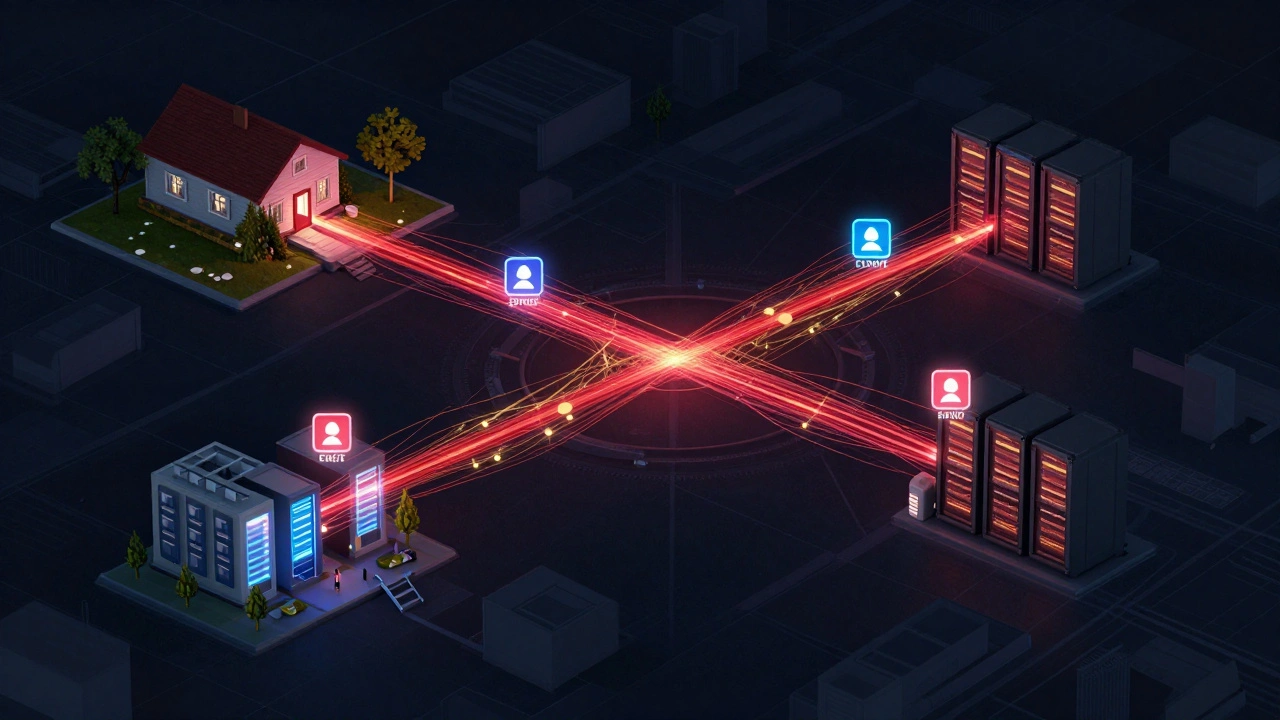
- Between-Log Mapping - Link events across devices. Did the same IP address appear in the victim’s firewall logs and the suspect’s router logs?
- Within-Device Mapping - Show how different data types on one device relate. For instance, a deleted file’s metadata matches a network connection timestamp.
- Scan - Source IP, destination IP, port, timestamp
- Exploit - Type of vulnerability used, tool ID, success flag
- Impact/Effect - File altered, system rebooted, data exfiltrated
The Hidden Problem: Incomplete Logs
Here’s the catch: traceability only works if logs exist. And they often don’t. Scans? Only visible in personal firewall logs. Exploits? Only in firewall or IDS logs. Impacts? Only in system or application logs. If any one of those systems was turned off, wiped, or never configured to log, the trace breaks. In 68% of multi-jurisdictional cases, investigators reported inconsistent logging formats - meaning a Windows event log from a corporate server didn’t match the Linux syslog from a home router. This isn’t just a technical issue. It’s a procedural one. Too many agencies still treat digital evidence like physical evidence - collect it, bag it, label it - without thinking about the digital breadcrumbs left behind.How to Fix It: Standardized Tagging
The solution isn’t more software. It’s better tagging. Every piece of evidence - whether it’s a hard drive, a phone, or a firewall log - needs a unique identifier that links it to the incident pattern it belongs to. The European Network of Forensic Science Institutes found that using standardized tags reduced evidence handling errors by 32% in multi-scene cases. For example:- Item ID: DS-2026-014-A
- Incident Pattern: Attacker-Scan-Exploit-Exfil
- Linked Items: DS-2026-014-B (router logs), DS-2026-014-C (victim laptop)
- Trace Confidence: 99.7%
AI Is Changing the Game - But Not Replacing Humans
The FBI’s 2024 Digital Evidence Framework introduced AI-powered mapping that boosted mapping rates to 99.8% in testing. That’s impressive. But here’s the danger: 7.3% of automatically mapped traces were later proven wrong in a 2018 DOJ pilot program. In one case, AI linked two devices because they shared the same router MAC address - but one belonged to the suspect’s neighbor. Dr. Eoghan Casey warned in Digital Evidence and Computer Crime: "Over-reliance on automated traceability systems without manual verification creates false confidence in evidence links." The best systems combine AI speed with human judgment. AI finds the links. A trained investigator validates them. That’s why the SWGDE guidelines updated in January 2025 now require explicit documentation of evidence relationships - not just automated reports.
What’s Next? Mandatory Traceability by 2030
The writing is on the wall. The RAND Corporation predicts traceability-enhanced custody systems will be mandatory in 90% of digital investigations by 2030. The EU Cybersecurity Act already requires 100% trace mapping verification for cross-border cases. Fortune 500 companies have doubled their adoption of traceability systems since 2018 - from 29% to 63%. The National Institute of Justice’s 2025 roadmap sets a clear target: reduce evidence linkage errors by 40% by 2027. That means agencies that still treat digital evidence as isolated items are falling behind.What Investigators Need to Do Today
You don’t need a $500,000 lab to start. Here’s what works now:- Tag everything - Assign a unique incident ID to every piece of evidence, physical or digital. No exceptions.
- Log everything - If you’re collecting a device, document what logs it can produce. Don’t assume.
- Link manually - Use simple spreadsheets or free tools to map connections between items. Don’t wait for AI.
- Train your team - Experienced investigators need 40-60 hours of training to use traceability methods effectively. Start there.
What’s the difference between chain of custody and traceability?
Chain of custody tracks who handled evidence and when. Traceability shows how evidence items are connected across scenes, devices, and events. One is about handling; the other is about meaning.
Can traceability work if logs are incomplete?
It’s harder, but not impossible. Investigators can still use partial data to build patterns - like connecting a suspect’s phone to a location via geotagged photos, even if network logs are missing. The key is documenting what’s missing and why, not pretending the data is complete.
Is traceability only for cybercrime cases?
No. It applies to any multi-scene investigation where digital evidence is involved - from homicide cases with surveillance footage and phone records to financial fraud with transaction logs and encrypted drives. Anytime evidence comes from more than one location, traceability adds value.
Do I need expensive software to implement traceability?
No. Many investigators start with spreadsheets, free forensic tools like Autopsy or FTK Imager, and manual tagging. The goal isn’t fancy tech - it’s consistent documentation. Software helps scale, but doesn’t replace good process.
What happens if traceability links are wrong?
If a link is incorrect, it can lead to false conclusions - like accusing the wrong person. That’s why manual review is required. Automated systems flag possible links; human investigators confirm them. The 2024 Interpol Forensic Science Symposium found that 15% of AI-generated links needed correction through human review.